METRO Germany has launched a multi-month pilot with Omnivore Recycling to test whether black soldier fly larvae can convert unavoidable food waste into feed ingredients and organic fertilizer, adding another…
METRO Germany has launched a multi-month pilot with Omnivore Recycling to test whether black soldier fly larvae can convert unavoidable food waste into feed ingredients and organic fertilizer, adding another commercial use case for insect-based circular systems.
By IIR Editorial Desk · October 14, 2026 · Latest Coverage
METRO Germany has started a multi-month recycling pilot with Omnivore Recycling using black soldier fly larvae to process unavoidable food waste from its wholesale operations. The project is designed to recover nutrients from organic residual streams that are no longer suitable for human consumption and return them to agricultural value chains as insect biomass and organic fertilizer.
According to METRO Germany’s official announcement, the pilot collects organic food waste directly from a METRO wholesale market before it enters the black soldier fly recycling process. The initiative forms part of the company’s broader effort to find higher-value uses for unavoidable food losses that cannot be redistributed through food donation channels.
How the Black Soldier Fly Pilot Works
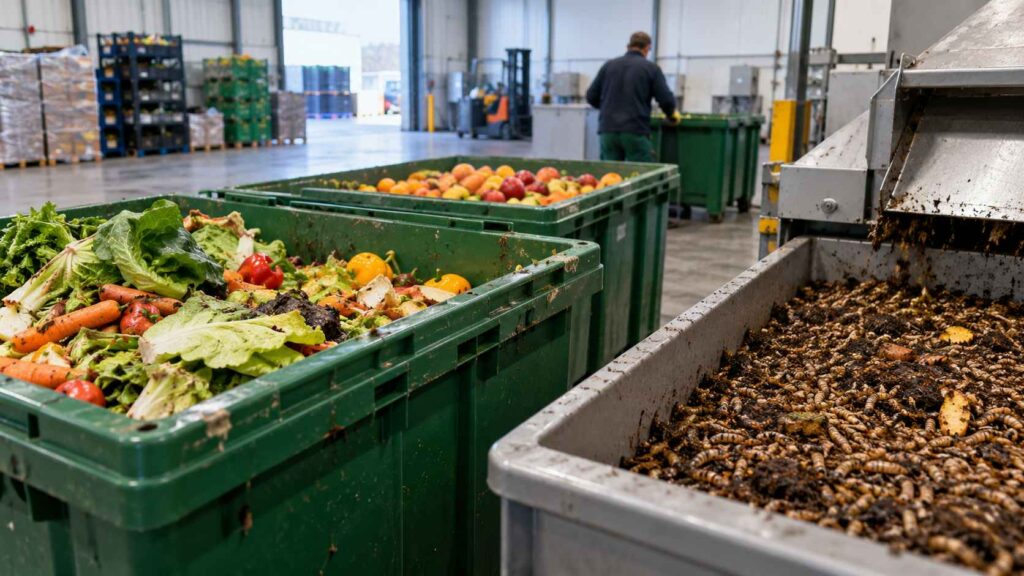
The waste stream includes products such as fruit, vegetables, yogurt and pasta. METRO says meat and fish residues are excluded from the process. The collected materials are unpacked, sorted and processed into a substrate suitable for the larvae, which are then reared in dedicated containers.
During the bioconversion process, black soldier fly larvae transform nutrients contained in the residual food into insect biomass. METRO says the resulting material can serve as an alternative feed ingredient for poultry, pigs and aquaculture, while larval residues can also be used as organic fertilizer in agriculture.
The project therefore differs from conventional food-waste treatment systems that primarily recover energy. Its objective is to retain more of the nutritional value contained in the original material by converting it into products that can re-enter agricultural production.
Why the Project Matters for the Insect Industry
For the insect sector, the significance of the pilot extends beyond the volume of larvae that may ultimately be produced. It represents another example of black soldier fly technology being positioned directly within a commercial food-waste management system rather than operating solely as a standalone insect-production business.
That distinction matters because the economics of insect production depend heavily on what happens before larvae enter the rearing stage. Feedstock collection, sorting, preprocessing, transport and consistency all influence production efficiency. These upstream activities are an important part of the broader black soldier fly supply chain, alongside rearing, processing, quality control and distribution.
Large food wholesalers could therefore become strategically important participants in future insect-production networks. Their operations generate recurring organic residual streams, while centralized logistics can potentially make collection and preprocessing more structured than highly fragmented sources of food waste.
At the same time, the METRO project remains a pilot rather than evidence of full commercial deployment. METRO has not disclosed processing capacity, expected insect output, operating costs or the economics of the resulting feed ingredients. Those factors will determine whether the model can ultimately compete with other waste-management routes at larger scale.
What the Industry Should Watch Next
The next question is whether the pilot can demonstrate a repeatable operating model across larger or multiple wholesale locations. Consistent substrate composition will be important because food residual streams can vary significantly by season, product category and individual site.
The industry should also watch how preprocessing requirements affect overall economics. Separating packaging, excluding unsuitable materials and preparing a stable feeding substrate can add operational complexity before black soldier fly larvae begin converting the material.
Another important issue will be the destination of the resulting insect biomass. Producing larvae efficiently is only part of the commercial equation; reliable demand from feed manufacturers and other downstream buyers remains necessary for a circular system to operate at meaningful scale.
If the project performs successfully, the broader implication may be more significant than a single recycling initiative. It could strengthen the case for closer integration between food distribution companies, organic-waste operators and insect producers, creating supply systems in which black soldier fly technology functions as part of the waste and agricultural infrastructure rather than as an isolated production process.
For now, the METRO pilot is best viewed as another commercial test of that model—and one worth watching as the insect industry searches for scalable applications beyond traditional standalone production facilities.