Independent intelligence for the global insect industryISSUE 01 · 2026
Earthworm Industry: Market, Production, and Commercial Applications
By IIR Editorial DeskOctober 6, 2026
The earthworm industry connects vermiculture and organic-resource processing with vermicompost, animal nutrition and other commercial applications.
This analysis examines the earthworm industry from commercial vermiculture and vermicomposting to worm biomass, animal feed and aquaculture applications, while assessing the production, quality and market constraints shaping further commercialization.
By IIR Editorial Desk · October 6, 2026 · Market Intelligence
The earthworm industry occupies a distinctive position within the broader biological-resource economy. Unlike insect sectors built primarily around protein production, earthworm businesses can generate value through several interconnected activities, including vermiculture, organic-resource processing, vermicompost production, and the sale of worm biomass for animal nutrition and other applications.
Earthworms are not insects; they are annelids. Their inclusion in the broader commercial alternative-protein and bioconversion landscape reflects overlapping markets rather than biological classification. For IIR, the commercially relevant question is how controlled earthworm production interacts with feed, aquaculture, organic-resource management, and agricultural-input markets.
This distinction matters because the economics of the sector cannot be measured only by tonnes of earthworm biomass. In many production systems, worms are part of a multi-output process in which the biological conversion of organic material creates both worm biomass and agricultural products.
1. The Earthworm Industry Extends Beyond Worm Biomass
Commercial earthworm production is closely associated with vermiculture and vermicomposting. Vermiculture focuses on maintaining and multiplying earthworm populations under controlled conditions, while vermicomposting uses earthworms together with microorganisms to transform suitable organic materials into more stabilized products.
This creates a fundamentally different industry structure from a single-output livestock system. Producers may generate revenue from worms, vermicompost, and related vermiculture products, while the processing of organic materials can itself provide environmental or agricultural value.
The relative importance of these outputs varies considerably between businesses. Some operations are designed primarily around fertilizer production, while others produce worm biomass for bait, animal nutrition, breeding stock, or specialized markets. The earthworm industry is therefore better understood as a collection of overlapping value chains than as one standardized commodity market.
2. Vermiculture Provides the Production Foundation
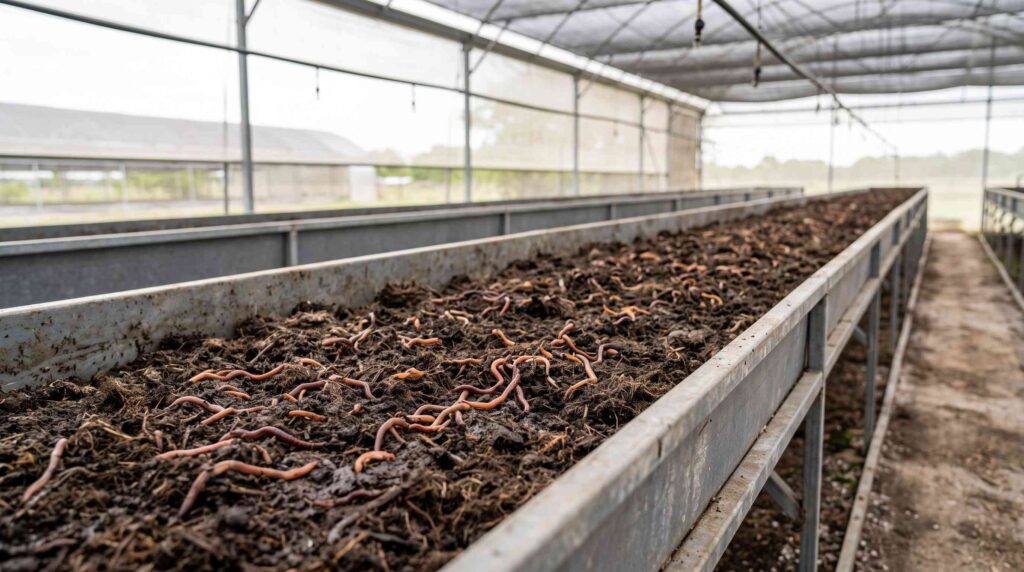
Commercial vermiculture depends on maintaining suitable substrate, moisture, temperature, stocking conditions, and reproduction. Earthworms consume and transform organic matter while microorganisms participate in decomposition, making substrate management central to both biological performance and final product quality.
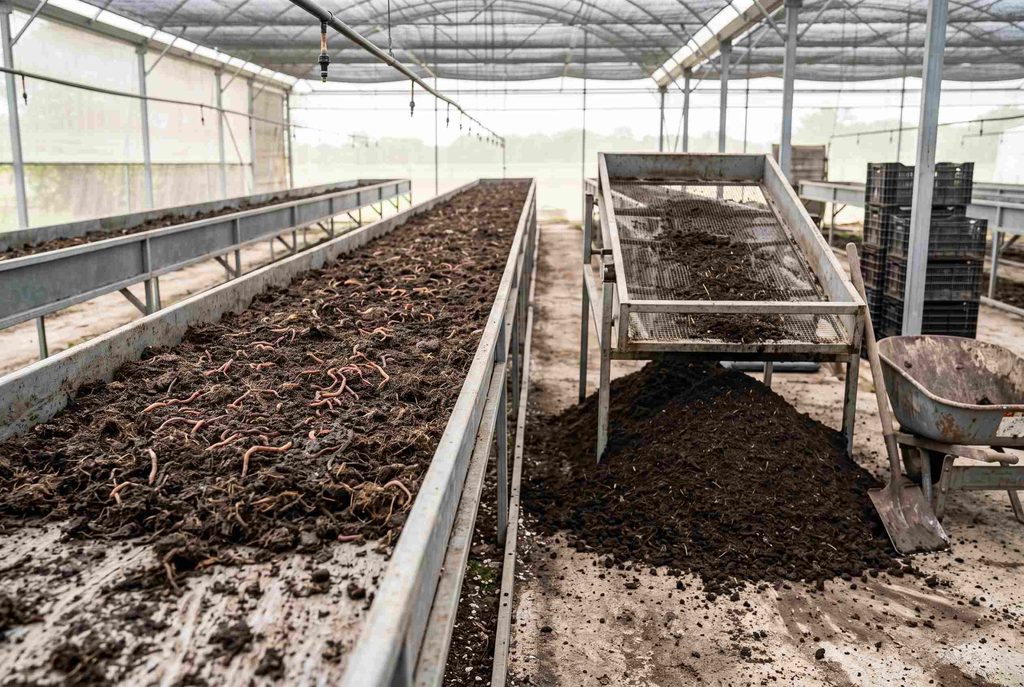
Production systems range from relatively simple beds and windrows to more controlled flow-through systems. The appropriate design depends on climate, labor availability, feedstock, production objective, and scale. A facility focused on vermicompost may optimize material throughput differently from one seeking to maximize harvestable worm biomass.
Scaling, therefore, involves more than adding additional worms. Producers need a consistent supply of suitable organic material, sufficient processing area, moisture management, harvesting systems, and markets capable of absorbing the resulting outputs.
3. Species Selection Depends on the Production Objective
The commercial term “earthworm” covers multiple species with different ecological and production characteristics. Eisenia fetida is particularly important in vermiculture research and commercial vermicomposting because of its reproductive performance and suitability for organic substrates.
Other species can be relevant depending on geography and application. The appropriate worm for composting, biomass production, or local agricultural systems is not necessarily identical, and species should not be treated as commercially interchangeable without considering production conditions.
This is particularly important when discussing animal nutrition. Research findings obtained with one earthworm species, processing method, or substrate should not automatically be generalized to all earthworm-derived feed products.
4. Vermicompost Is a Major Commercial Output
Vermicompost is one of the most established commercial products associated with earthworm production. Earthworms and microorganisms transform organic feedstocks into a material used in agriculture and horticulture, creating a commercial connection between waste management, soil health, and crop production.
The broader product category can also include vermiwash, vermicompost-derived liquid products, and other biological inputs. Their commercial maturity and regulatory treatment vary, and emerging products should not be confused with established vermicompost markets.
A 2025 review of earthworm-derived vermiproducts describes commercial adoption across multiple agricultural markets and emphasizes the need for quality control and product standardization. This reinforces the importance of viewing earthworm production as both an agricultural input industry and a potential protein industry.
5. Animal Feed Creates a Second Commercial Pathway
Earthworm biomass contains nutritionally relevant protein and has been investigated as an alternative feed material for poultry and fish. This creates a second value chain in which worms are harvested, cleaned, and processed rather than remaining solely part of the vermicomposting system.
The technical opportunity is supported by a substantial research history, but commercial maturity should not be overstated. Reviews of earthworm meal note promising nutritional characteristics while also identifying limitations around production scale, processing, palatability, safety, and economics.
This creates an important distinction between technical suitability and recurring commercial demand. Feeding trials can demonstrate that earthworm-derived ingredients have nutritional value, but industrial adoption requires standardized production, consistent specifications, regulatory access, and competitive economics.
6. Aquaculture Has a Strong Research Base
Aquaculture represents one of the clearest animal-nutrition applications for earthworm biomass. Eisenia fetida has been studied as a non-conventional protein source for fish feeds because of its protein content, amino acid profile, reproduction, and potential integration with organic-resource processing.
Research has evaluated earthworm meal across multiple aquatic species and production systems. Reviews indicate potential for partial replacement of conventional protein ingredients, although performance depends on species, inclusion level, and processing method. The evidence supports aquaculture as an important application pathway, but not the assumption that earthworm meal has already become a globally standardized aquafeed commodity.
The commercial opportunity may be particularly relevant where vermiculture is integrated with farms that already generate suitable organic materials. In such systems, earthworm production can potentially connect resource management, fertilizer production, and on-farm feed strategies.
7. Product Form Determines the Buyer and Value Chain
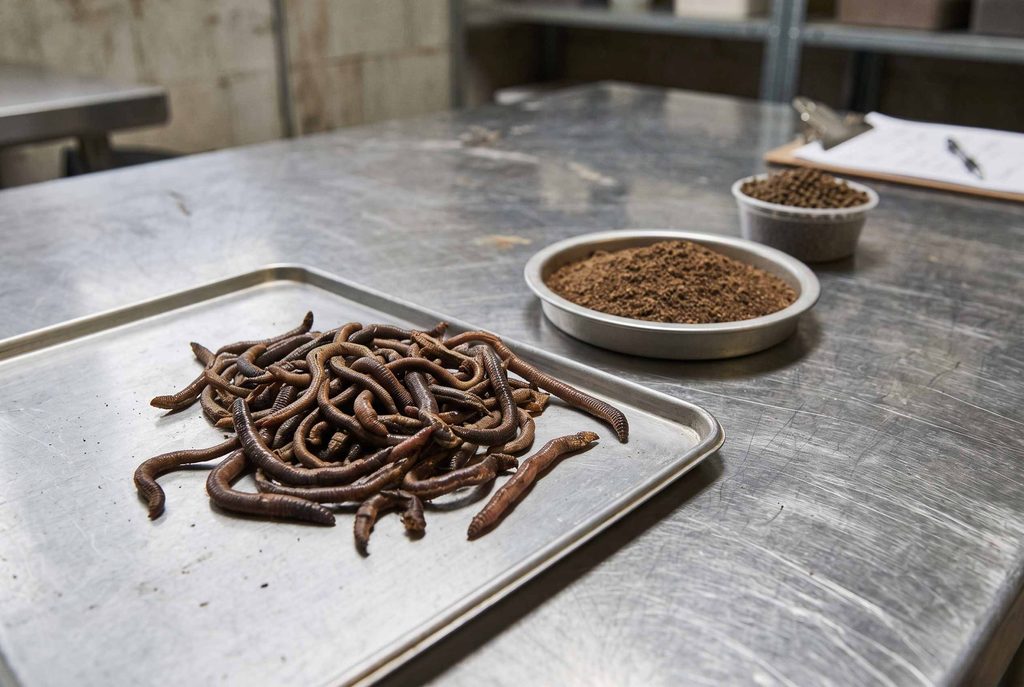
Commercial earthworms can reach buyers in several forms. Live worms serve vermiculture, bait, and selected animal-feeding markets, while fresh or processed biomass can enter other applications. Drying and grinding create products that are easier to store, transport, and incorporate into formulated feeds.
Each product form creates a different supply chain. Live worms require biological handling and shorter distribution cycles, whereas dried whole earthworms and earthworm meal can support longer storage and broader geographic distribution when processed and packaged appropriately.
Processing also changes the commercial specification. Feed buyers are likely to focus on nutritional composition, microbiological quality, contaminants, and batch consistency, while buyers of breeding stock or live worms prioritize biological viability and species identity. The earthworm industry, therefore, cannot be analyzed through one universal product specification.
8. Substrate Quality Is Both an Opportunity and a Risk
The ability of earthworms to utilize organic materials is one of the industry’s central advantages. Agricultural residues, manure, and other suitable materials can potentially be converted into valuable outputs, creating a circular production model.
The same biological characteristic creates a significant quality-control challenge. Earthworms can accumulate contaminants present in their environment, including heavy metals and other undesirable substances. Reviews of earthworms used in animal feed consequently emphasize the importance of controlled vermiculture and substrate management rather than uncontrolled collection from potentially contaminated soils.
For commercial production, the substrate therefore affects more than growth. Its origin and condition can influence safety, final-product composition, and market eligibility. Traceable, controlled production becomes increasingly important as earthworm biomass moves from local agricultural use to formal feed and ingredient supply chains.
9. Regional Production Remains Diverse and Fragmented
Earthworm production exists across many regions, but the industry does not resemble a single globally standardized manufacturing sector. Production models differ according to climate, available organic materials, agricultural systems, labor economics, and local demand for vermicompost or worm biomass.
Commercial vermicomposting can operate through windrows, beds, flow-through systems, and other configurations. Small farms may integrate worm production directly with livestock, aquaculture, or crop operations, while specialized businesses can focus on large-scale organic resource processing or agricultural input production.
This fragmentation makes global capacity difficult to measure. Vermicompost production volumes, worm biomass production, and feed-ingredient capacity should not be combined into one figure without distinguishing the underlying product and production system.
10. Commercial Growth Depends on Standardization
The next stage of development depends less on proving that earthworms can process organic material or provide useful nutrients. Both functions are already well established scientifically. The commercial challenge is converting those biological capabilities into repeatable products.
For vermicompost, this means controlling feedstock, maturity, moisture, nutrient characteristics, and contaminants. For animal-feed applications, producers need to manage species identity, substrate, harvesting, processing, nutritional composition, microbiological quality, and storage.
Market development will therefore differ by product. Vermicompost already operates within established agricultural-input markets, while earthworm-derived feed ingredients remain a more specialized and developing opportunity. Emerging bioactive or refined earthworm-derived products sit further along the commercialization curve.
IIR Analysis
The earthworm industry should not be evaluated as a direct equivalent of the BSF, mealworm, or cricket industries. Its commercial foundation is broader and, in many cases, more closely connected to vermiculture, vermicomposting, and agricultural inputs than to dedicated protein manufacturing.
Its most interesting economic characteristic is the possibility of generating multiple forms of value from the same biological system:
Animal feed and aquaculture create credible growth pathways, but research potential should not be mistaken for established global demand. The industry’s long-term development will depend on whether producers can combine the established economics of vermiculture and vermicompost with standardized, safe, and commercially scalable earthworm-derived ingredients.
Disclaimer: This article is for informational purposes only and does not constitute business, legal or investment advice. Always consult primary sources and qualified professionals.