Independent intelligence for the global insect industryISSUE 01 · 2026
Housefly Larvae Supply Chain: From Rearing to Ingredient Distribution
By IIR Editorial DeskOctober 5, 2026
This analysis examines how commercial housefly larvae move through the supply chain, from substrate sourcing and controlled rearing to harvesting, processing, quality release, storage, international trade and B2B ingredient distribution.…
This analysis examines how commercial housefly larvae move through the supply chain, from substrate sourcing and controlled rearing to harvesting, processing, quality release, storage, international trade and B2B ingredient distribution.
By IIR Editorial Desk · October 5, 2026 · Market Intelligence
The commercial housefly larvae supply chain begins before larvae enter a rearing tray and continues well beyond the farm. Substrate sourcing, breeding, rearing, harvesting, processing, quality control, storage, and distribution all influence whether Musca domestica biomass can become a reliable commercial ingredient.
This makes the supply chain more complex than a simple movement of insects from producer to buyer. Housefly larvae can utilize diverse organic materials, but the origin and condition of those materials can affect production performance, product composition, and regulatory eligibility. Once harvested, the biomass must also be stabilized and processed into a format that can withstand storage, transportation, and downstream handling. Commercial supply, therefore, depends on maintaining control across the entire chain.
1. The Supply Chain Starts With Substrate Control
Substrate is the first major input in the housefly larvae supply chain. Producers may have access to food-related residues, agricultural by-products, manure, or other organic materials, but technical suitability for larval growth does not automatically make every material acceptable for every commercial application.
For commercial feed supply, substrate origin becomes particularly important because regulations can restrict which materials may be used to rear insects entering the feed chain. This creates a direct connection between upstream sourcing and downstream market access. A producer cannot assume that a larva becomes commercially eligible simply because the finished biomass meets a basic nutritional specification.
Traceability, therefore, needs to begin with incoming material. Supplier identity, substrate category, collection conditions, storage, and batch records can become part of the information needed to support consistent production and demonstrate how the resulting ingredient was produced.
2. Rearing Converts Substrate Into Commercial Biomass
Controlled rearing converts the incoming substrate into larval biomass. Egg supply, substrate preparation, stocking density, environmental conditions, and harvest timing determine how effectively the facility transforms available material into usable output.
Housefly larvae are attractive partly because they can utilize low-value residual organic streams. Recent research nevertheless emphasizes that the rearing substrate serves simultaneously as the larvae’s feed and living environment, meaning that substrate conditions and nutrient availability can affect both production performance and resulting larval composition.
From a supply-chain perspective, this means the characteristics of the final ingredient cannot be separated completely from upstream production. Buyers seeking repeatable specifications need suppliers capable of controlling biological variation rather than simply producing large quantities of larvae.
3. Harvesting Connects Farming With Ingredient Processing
Harvesting is the first major transition from insect farming to ingredient manufacturing. Larvae must be recovered from the remaining substrate efficiently enough to preserve biomass yield while limiting unwanted material entering the downstream process.
Screening, sieving, and other separation methods can be used depending on the substrate and facility design. The commercial objective is not simply high recovery. The recovered larvae also need to meet cleanliness requirements appropriate for the next processing stage.
This creates an important operational boundary. Before harvest, the system is primarily managing biological production. After harvest, the focus increasingly shifts toward stabilization, product safety, processing consistency, and commercial specifications.
4. Stabilization Creates a More Manageable Product
Freshly harvested housefly larvae contain substantial moisture and are not naturally suited to extended storage or long-distance ingredient distribution. Post-harvest stabilization, therefore, needs to occur quickly enough to control deterioration and prepare the biomass for further processing.
Depending on the intended product, stabilization can involve cleaning, thermal treatment, freezing, or direct movement into a drying process. The choice affects production flow as well as product characteristics. A facility producing fresh material for nearby use operates under a different logistics model from one supplying dried ingredients across regions or international markets.
Stabilization is therefore a supply-chain function as much as a processing function. It changes a rapidly deteriorating biological material into an intermediate product that can move more reliably through subsequent manufacturing and distribution stages.
5. Processing Determines Which Market the Product Can Enter
Housefly larvae can move into several commercial formats after harvesting. Whole dried larvae require relatively limited transformation, while larval meal adds grinding and particle-size control. Further processing can separate oil or produce more concentrated protein-rich fractions.
These formats serve different buyers and create different supply-chain requirements. A whole dried product may prioritize physical appearance and moisture control, while a feed manufacturer purchasing meal is more likely to focus on composition, particle characteristics, microbiological parameters, and formulation consistency.
Processing, therefore, creates market segmentation. The same biological raw material can enter different commercial channels depending on how it is stabilized, transformed, specified, and approved for its intended use.
6. Quality Release Is a Critical Supply Chain Gate
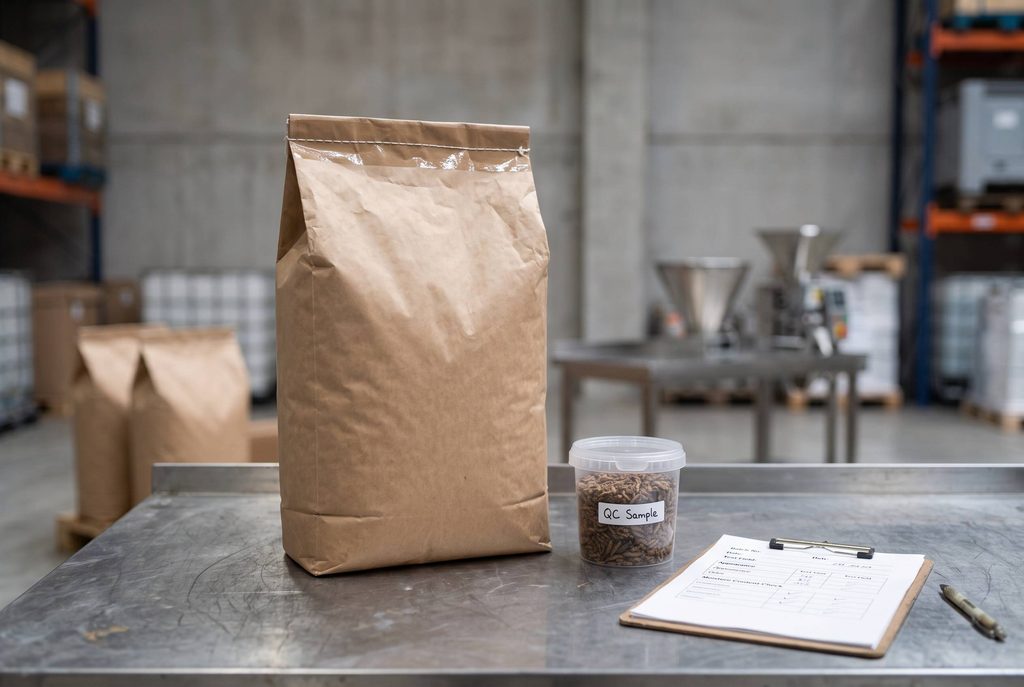
A processed product is not automatically ready for commercial distribution. Quality release provides the boundary between manufacturing and saleable inventory by confirming whether a batch meets the supplier’s specification and applicable buyer or regulatory requirements.
Relevant controls can include moisture, nutritional composition, microbiological parameters, contaminants, and batch identification. The precise testing program depends on product format, intended use, and destination market, so there is no single universal specification for all housefly-derived ingredients.
Traceability becomes particularly important at this stage. A commercial batch should be connectable to its production and processing history, allowing suppliers and buyers to identify what was produced, how it was processed and which batch entered storage or shipment.
7. Storage and Packaging Protect Commercial Value
Once released, the ingredient must retain its required characteristics until it reaches the buyer. Moisture exposure, temperature, oxygen, packaging integrity, and storage duration can influence the stability of dried insect products, particularly those containing meaningful levels of fat.
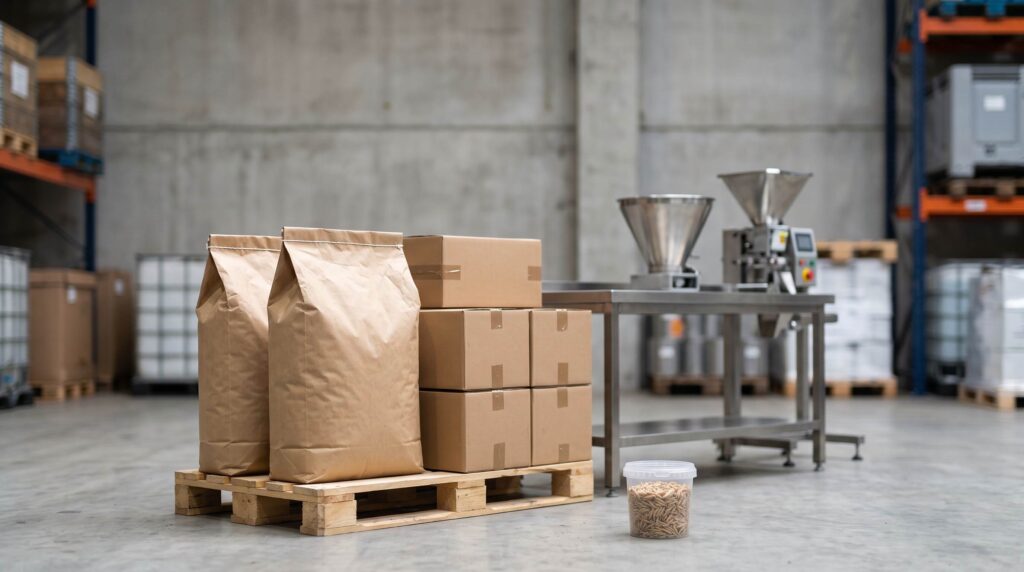
Packaging, therefore, serves more than a transport function. It helps protect the product from environmental exposure while providing a practical unit for inventory control, labeling, and batch traceability. The appropriate packaging system depends on whether the product is supplied as whole larvae, meal, or another processed ingredient.
Inventory management also matters. Producing large volumes without matching sales or storage capacity can extend holding periods and increase working-capital requirements. A reliable supply chain needs to coordinate production output with processing capacity, available inventory, and buyer demand.
8. International Trade Adds Regulatory and Documentation Requirements
International distribution adds another layer to the housefly larvae supply chain because regulatory eligibility depends on destination, product form, and intended use. Feed materials and animal-derived products can be subject to requirements covering approved species, production establishments, substrates, processing methods, health certification, and border controls.
For example, European rules recognize Musca domestica among the species that can be used for processed animal protein from farmed insects under specified conditions. Those rules also connect market access with eligible substrates and controlled processing, demonstrating why regulatory compliance cannot be added only at the final shipping stage.
Import requirements can extend beyond the product itself. Approved establishments, official documentation, health certificates, shipment identification, and border inspection may all become part of international distribution depending on the destination and product category. Export-oriented suppliers, therefore, need to evaluate market access before production rather than after inventory has already been manufactured.
9. Importers and Distributors Connect Production With Buyers
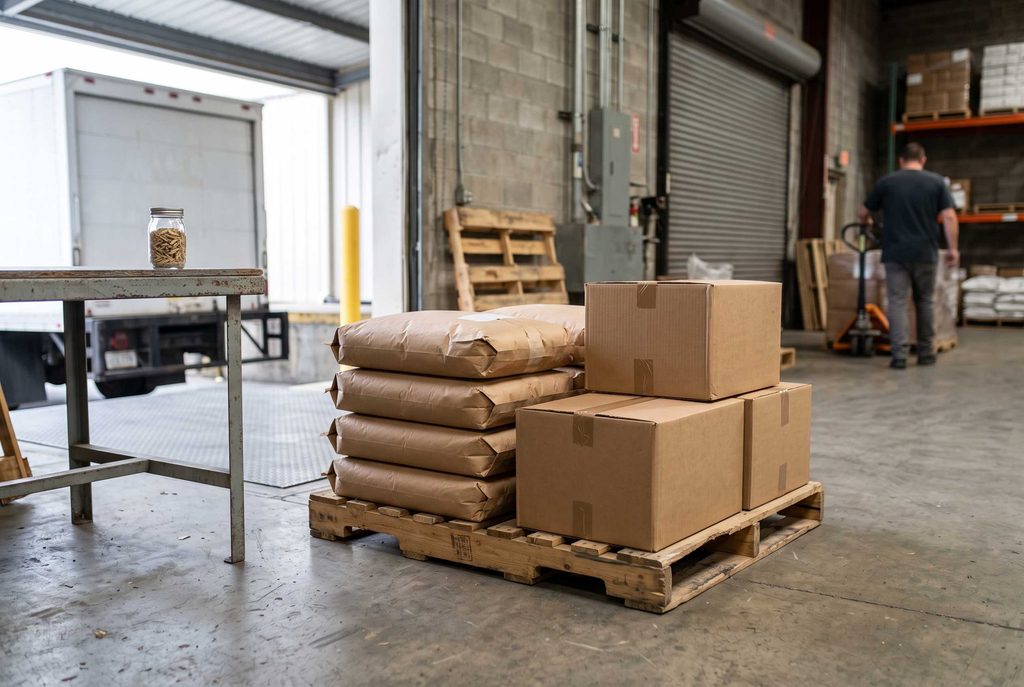
Not every feed manufacturer or downstream buyer will source directly from an insect-rearing facility. Importers, ingredient distributors, and specialized feed suppliers can provide an intermediate commercial layer by consolidating shipments, maintaining local inventory, and managing relationships with multiple buyers.
This function becomes particularly relevant when production and consumption are geographically separated. International buyers may require smaller quantities, shorter lead times, or local commercial support than a large production facility is designed to provide directly.
Distributors can also help translate upstream production specifications into downstream procurement requirements. However, additional intermediaries increase the importance of batch identification and documentation because product information must remain connected to the physical material as it moves between organizations.
10. Supply Reliability Depends on the Entire Chain
Production capacity and supply reliability are not the same thing. A facility may have substantial theoretical larval output but still struggle to deliver consistent commercial quantities if substrate supply, harvesting, drying, testing, storage, or logistics become bottlenecks.
The housefly larvae supply chain is therefore best understood as an interconnected system:
Each stage can constrain the next. A disruption in substrate sourcing can reduce biological production, insufficient drying capacity can delay processing, failed quality release can remove inventory from sale, and incomplete documentation can prevent an otherwise acceptable product from entering its destination market.
For commercial buyers, reliable supply ultimately means more than access to larvae. It means access to the required product specification, quantity, and documentation at the required time.
IIR Analysis
The defining characteristic of the housefly larvae supply chain is the unusually strong connection between upstream substrate control and downstream market access. The species can convert diverse organic materials into useful biomass, but a technically effective substrate is not necessarily acceptable for every commercial feed market. This means supply-chain design must begin with the destination product and market rather than treating regulatory eligibility as a final export check.
Commercial scale will also depend on the industry’s ability to move from biological production to repeatable ingredient distribution. Rearing capacity matters, but buyers ultimately depend on harvesting efficiency, stabilization, processing, quality release, inventory management, and documentation. The strongest housefly larvae supply chains will therefore be those that preserve traceability and product consistency from the incoming substrate through to the final B2B buyer.
Disclaimer: This article is for informational purposes only and does not constitute business, legal or investment advice. Always consult primary sources and qualified professionals.