Independent intelligence for the global insect industryISSUE 01 · 2026
Housefly Larvae Production Cost: Key Drivers of Commercial Economics
By IIR Editorial DeskOctober 5, 2026
Housefly larvae production economics depend on substrate sourcing, labor, biological yield, processing and facility utilization. This analysis examines the variables that determine commercial production cost.
This analysis examines the main drivers of housefly larvae production cost, including substrate sourcing, labor, biological performance, harvesting, drying and facility utilization, and how bioconversion can alter the economics of commercial production.
By IIR Editorial Desk · October 5, 2026 · Market Intelligence
Commercial housefly larvae production cost cannot be reduced to a single global cost per kilogram. Production systems differ in substrate source, labor requirements, environmental conditions, processing intensity, scale, and final product format. A facility that converts locally available organic residues into fresh larvae operates under a different cost structure than one that produces standardized dried meal for commercial feed markets.
The more useful approach is to examine how inputs are converted into saleable output. Housefly larvae can grow rapidly on relatively low-value organic materials, but inexpensive substrate alone does not guarantee low-cost production. Procurement, preparation, biological conversion, harvesting, drying and quality control all affect the final economics.
1. Substrate Economics Begin Before Larvae Are Added
Substrate is one of the defining economic variables in housefly larvae production. The ability to rear larvae on organic residues creates an opportunity to reduce feed-input costs, particularly where suitable materials are locally abundant and have limited alternative value. Economic studies of insect-based feed production have identified substrate procurement alongside labor as an important production-cost component.
The relevant cost, however, is not simply the purchase price of the material. Collection, transportation, sorting, storage, mixing and moisture adjustment can turn a nominally low-cost residue into a meaningful operating expense. A substrate located next to the production facility can have very different economics from the same material transported over a long distance.
Substrate choice also affects output. Different materials can produce different larval yields, individual weights and nutritional characteristics, so the economically attractive substrate is the one that produces useful saleable biomass at an acceptable total input cost rather than merely the cheapest material entering the facility.
2. Labor Remains a Major Operating Cost
Housefly larvae production involves repeated material-handling tasks across breeding, egg collection, substrate preparation, tray loading, harvesting, separation, cleaning and processing. When these operations depend heavily on manual work, labor can become one of the largest recurring costs.
This creates a strong relationship between facility design and labor economics. Poorly organized material flows increase handling time even when biological performance is good. A production system that requires repeated manual movement of substrate and larvae can therefore lose much of the cost advantage created by inexpensive feedstock.
Automation can reduce some repetitive work, but it introduces capital expenditure, maintenance and depreciation. The relevant question is not whether automation is inherently better, but whether the reduction in labor cost and improvement in throughput justify the additional investment at the facility’s operating scale.
3. Biological Performance Determines Cost per Unit of Output
Commercial economics depend on how efficiently substrate, production space and operating time are converted into harvestable larvae. Survival, development time, larval weight, total yield and substrate conversion performance therefore have direct economic consequences.
Recent experimental work shows that substrate and stocking density can materially affect housefly larval growth and conversion performance. Higher biological output from the same quantity of substrate or production space can spread operating costs across more saleable biomass, while poor growth or mortality has the opposite effect.
This is why production economics should be measured against saleable output rather than the number of eggs placed into a system or the volume of substrate processed. Inputs consumed by larvae that do not reach the required harvest or product specification still contribute to production cost.
4. Density Changes the Economics of Production Space
Stocking density is an economic variable because it affects how intensively a facility uses substrate and rearing space. Higher density can increase total larval yield under some conditions, but it can also reduce individual larval weight and alter metabolic performance. Research comparing different densities confirms that these effects interact with substrate type rather than following one universal pattern.
For commercial operators, maximum individual larval size and maximum biomass per tray are not necessarily the same objective. A production system must balance yield, development, substrate conversion and product requirements against the cost of available space.
The economically relevant target is therefore productive density: the stocking level that generates the best usable output from a given combination of substrate, time, labor and facility capacity.
5. Environmental Control Creates Location-Specific Costs
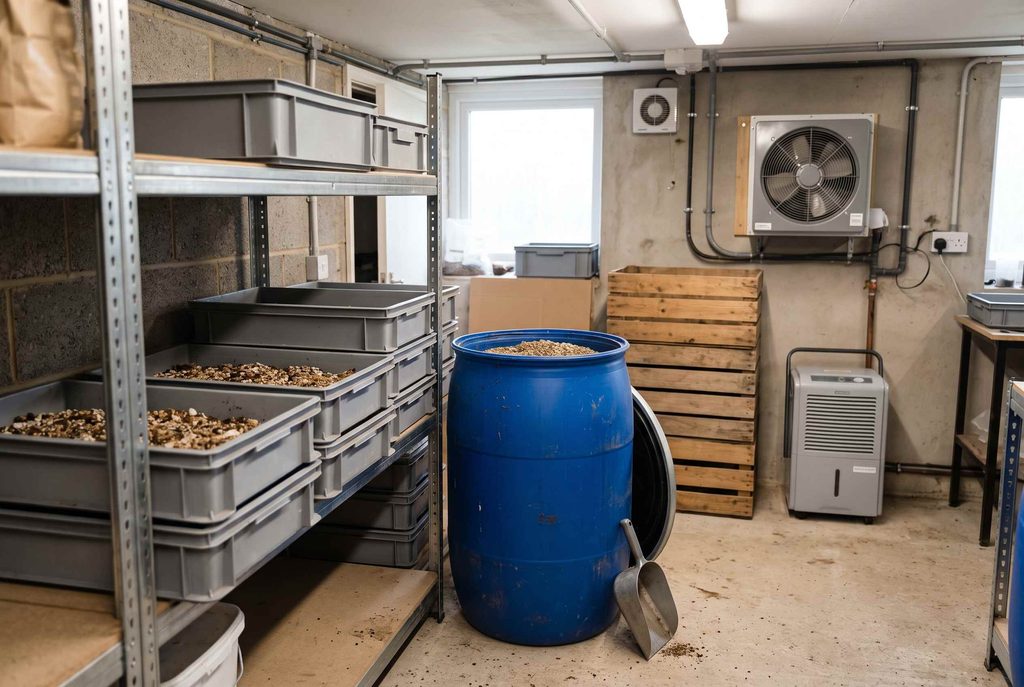
Housefly larvae develop rapidly under suitable environmental conditions, but commercial production still depends on maintaining an appropriate production environment. Temperature management, ventilation, and moisture control can create different energy requirements depending on geography, season, and facility design.
A warm climate may reduce heating requirements but can increase ventilation or cooling needs. Colder regions may require more enclosed production systems and additional heating. These differences make it difficult to transfer an energy-cost assumption from one production region directly to another.
Environmental control should therefore be evaluated according to cost per unit of saleable output. Energy use becomes commercially justified when it improves production continuity, development rate, or yield sufficiently to offset the additional operating expense.
6. Harvesting and Separation Add Handling Costs
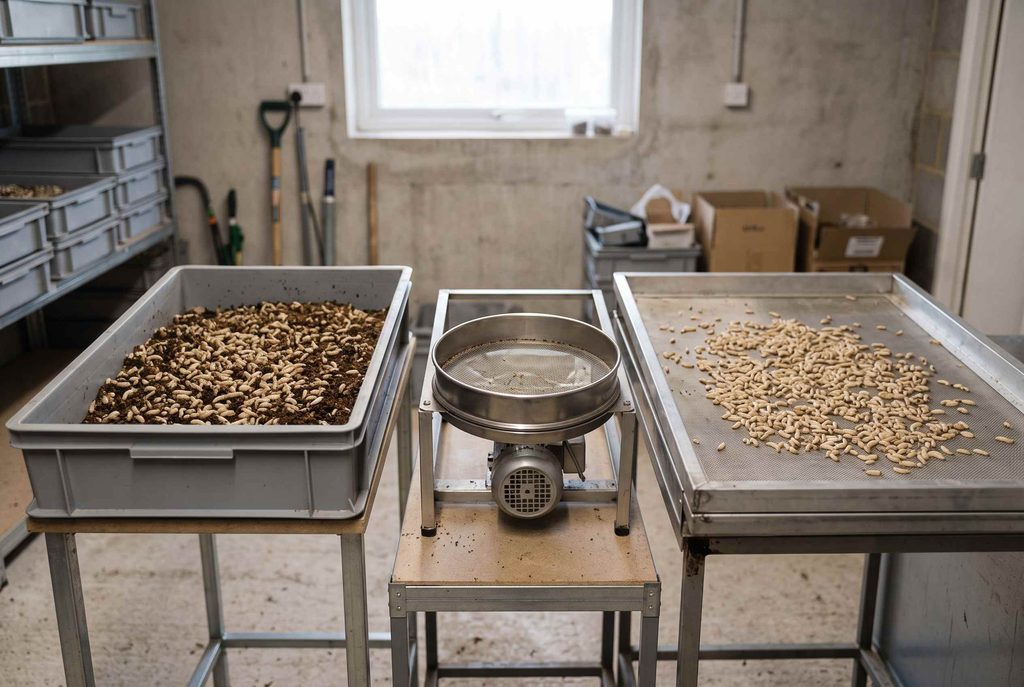
Larvae must be separated from residual substrate before they can become a commercial product. Screening, sieving, collection, and cleaning require labor, equipment, or both, and the physical properties of the substrate can materially influence how difficult this stage becomes.
A production system with high biological yield can still perform poorly economically if larvae are difficult to recover. Efficient separation reduces product losses and the amount of unwanted substrate carried into downstream processing.
Harvest economics, therefore, begin during substrate and production-system design. The best rearing medium is not necessarily the one that produces the greatest larval biomass if it creates disproportionate harvesting and cleaning costs.
7. Drying Can Become a Major Processing Cost
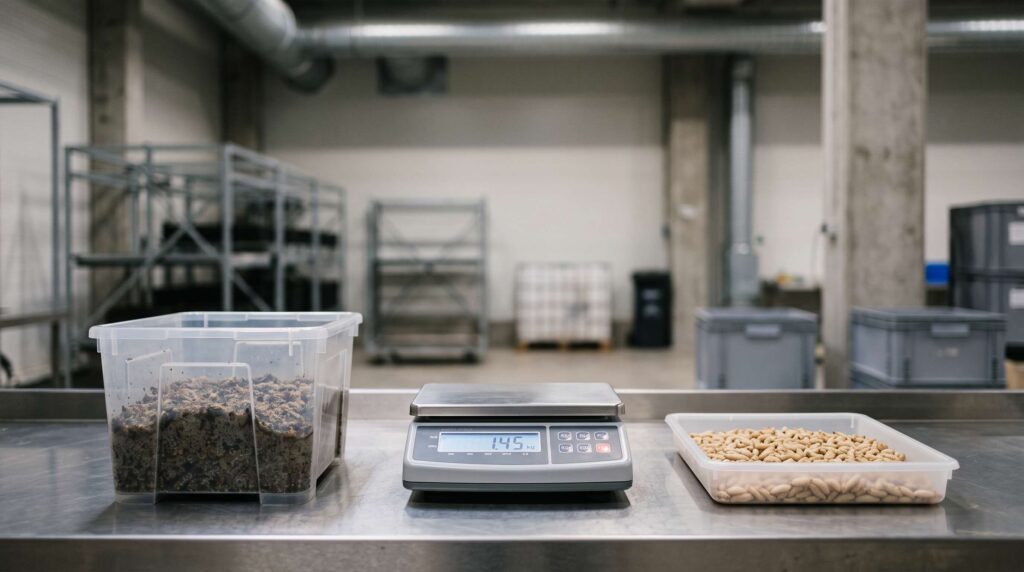
Fresh larvae contain substantial moisture, so producing a stable dried ingredient requires the removal of a significant amount of water. Drying introduces energy, equipment, labor, and time into the cost structure and can become an important production bottleneck when larval throughput increases.
The choice of drying technology changes both economics and product characteristics. Lower-cost methods may require more time or environmental dependence, while controlled thermal systems provide more predictable throughput but require energy and capital. Freeze-drying can preserve particular product characteristics but normally introduces a substantially different processing-cost structure from conventional thermal drying.
The appropriate comparison is therefore cost per kilogram of saleable dried output, not simply cost per kilogram of fresh larvae. Moisture loss means that fresh biomass and dried commercial product represent very different economic boundaries.
Larger equipment does not automatically create lower unit costs. Breeding rooms, rearing space, harvesting systems, dryers, and processing equipment generate fixed or semi-fixed costs that must be distributed across actual production.
A facility operating below its intended capacity can therefore have high unit costs even when its technical production system is efficient. Irregular egg supply, insufficient substrate, biological disruption, or downstream processing bottlenecks can all reduce utilization.
Scale becomes economically useful when the entire chain operates with sufficient throughput:
Adding capacity at one stage without matching the others can create idle equipment rather than genuine economies of scale.
9. Bioconversion Can Change the Economic Equation
Housefly larvae production has an important economic characteristic that distinguishes it from conventional feed-manufacturing processes: the production system can create value from organic materials that otherwise require management or disposal.
Full-scale research has demonstrated housefly larvae systems capable of converting livestock manure while generating larval biomass and residual material. Such systems can potentially create multiple value streams rather than relying solely on the selling price of larvae.
This does not mean that waste automatically has a negative cost or that every facility receives payment for processing it. The economic value of bioconversion depends on local waste-management costs, substrate ownership, transportation, regulation, and whether the residual material itself has a viable market. These factors must be evaluated separately for each production model.
10. Market Position Determines What Production Cost Is Viable
Production cost only becomes commercially meaningful relative to the product being sold. Fresh larvae, whole dried larvae, larval meal, and further processed ingredients have different production boundaries and different potential buyers.
Historical economic modeling of insect-based feed production found that labor and rearing substrate were major cost contributors and suggested that housefly larvae could be competitive with some conventional animal-protein ingredients under the specific West African scenarios studied. Those findings should not be treated as a universal global cost benchmark because input prices, infrastructure, scale, and market conditions differ substantially between regions.
The commercial question is therefore not simply, “How cheaply can housefly larvae be produced?” It is whether the complete production system can deliver the required product specification at a cost that allows the buyer, processor, and producer to operate economically.
IIR Analysis
The economics of housefly larvae production are best understood as a conversion system rather than a simple farming cost. Substrate and labor are important inputs, but unit economics ultimately depend on how effectively those inputs are converted into saleable biomass. Biological yield, harvesting efficiency, moisture removal, and facility utilization determine how costs are distributed across the finished product.
A useful conceptual framework is:
Substrate + Labor + Energy + Facility + Processing + Quality Control
Salable Larvae + Processed Ingredients + Potential Bioconversion Value
Housefly larvae can benefit from access to low-value organic streams, but that advantage disappears if substrate logistics, manual handling, poor biological performance, or expensive downstream processing consume the savings. The strongest commercial systems will therefore be those that optimize the complete conversion chain rather than simply minimizing one input cost.
Disclaimer: This article is for informational purposes only and does not constitute business, legal or investment advice. Always consult primary sources and qualified professionals.