Independent intelligence for the global insect industryISSUE 01 · 2026
Housefly Larvae Production: How Commercial Farming and Processing Work
By IIR Editorial DeskOctober 4, 2026
Commercial housefly larvae production combines controlled breeding, substrate preparation and larval rearing with harvesting, stabilization, drying and downstream processing.
This analysis explains how commercial housefly larvae production moves from breeding and egg collection through substrate-based rearing, harvesting and processing, and where environmental control, hygiene and product specifications affect commercial output.
By IIR Editorial Desk · October 4, 2026 · Market Intelligence
Commercial housefly larvae production turns the biological cycle of Musca domestica into a managed farming and processing system. The process begins with an adult breeding colony and continues through egg collection, substrate preparation, larval rearing, harvesting, separation, and post-harvest processing. For commercial operators, the objective is not simply to produce large numbers of larvae but to generate predictable quantities of usable biomass with consistent quality.
Housefly larvae can develop rapidly on a range of organic materials, which gives the species potential for both insect biomass production and resource recovery. That flexibility also creates a production challenge. The substrate serves simultaneously as feed and living environment, so its nutrient composition, moisture, physical properties, and microbiological condition can influence larval performance and the characteristics of the harvested biomass. Commercial production, therefore, depends on controlling the entire process rather than optimizing a single rearing parameter.
1. Commercial Production Starts With the Adult Colony
A reliable breeding colony is the upstream foundation of continuous housefly larvae production. Adult flies must be maintained under conditions that support survival, mating, and repeated egg production, while the production facility must prevent uncontrolled movement between breeding areas, larval rearing areas, and the external environment.
Commercial colony management consequently differs from the uncontrolled housefly populations commonly associated with manure or decomposing organic matter. Breeding cages, adult nutrition, water availability, environmental conditions, and oviposition management all become production variables. The goal is to convert a naturally opportunistic insect into a predictable biological production system.
The breeding stage also establishes an important capacity limit. Expanding the number of rearing trays or the amount of available substrate does not automatically increase output if the adult colony cannot supply enough viable eggs at the required time. Production capacity, therefore, begins upstream with colony performance rather than downstream with processing equipment.
2. Egg Production Determines Production Continuity
Egg collection connects the adult colony with larval production. Females require suitable oviposition conditions, and producers must collect and distribute eggs in a way that supports consistent larval batches. Variation at this stage can affect stocking density, development, and the timing of subsequent harvesting.
For a commercial operation, the relevant metric is not simply the total number of eggs produced. What matters is the ability to generate viable eggs on schedule and distribute them consistently across prepared substrate. Reliable propagation allows facilities to organize production into repeatable batches rather than responding to irregular biological output.
This becomes increasingly important as operations scale. A small facility can sometimes compensate manually for uneven egg supply, while a larger production system requires tighter coordination between breeding, substrate preparation, available rearing space, and planned harvesting.
3. Substrate Preparation Defines the Larval Environment
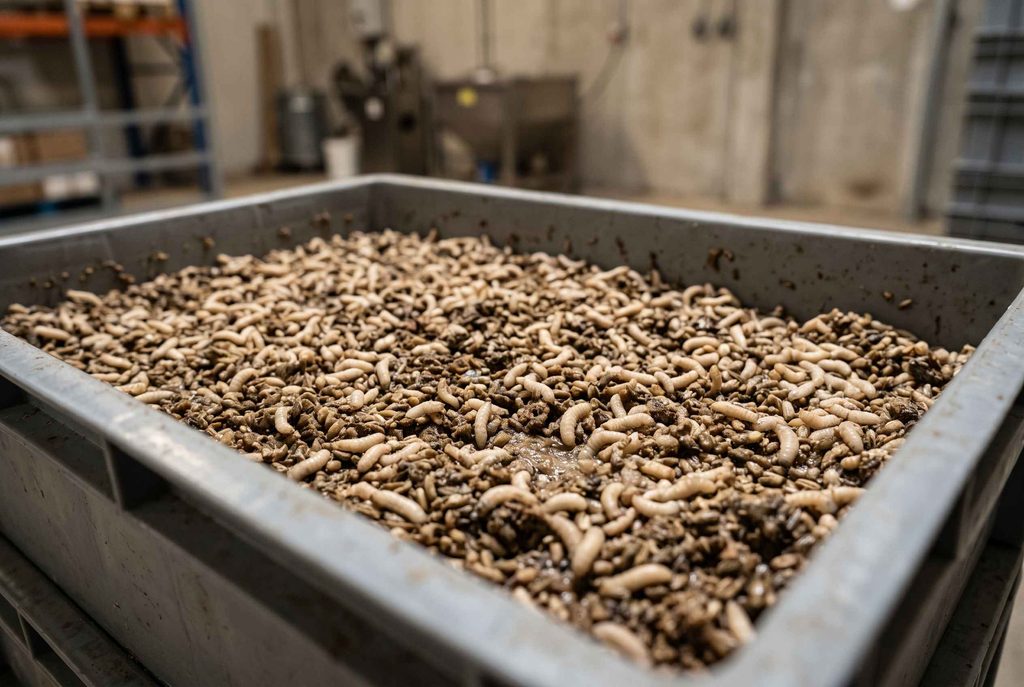
Substrate is one of the most important variables in housefly larvae production because it provides both nutrition and the physical environment for larval development. Research has evaluated manure, food-related residues, agricultural by-products, and formulated combinations of organic materials, demonstrating that housefly larvae can utilize diverse resources.
Flexibility does not mean that all substrates produce equivalent results. Nutrient composition, moisture, particle structure, and other substrate characteristics can influence development, biomass yield, and larval composition. Producers, therefore, need to evaluate substrate quality according to the intended commercial output rather than selecting material solely because it is inexpensive or locally available.
Substrate preparation also creates an important control point. Incoming material may require sorting, mixing, moisture adjustment, or other preparation before larvae are introduced. For feed-oriented production, substrate selection must additionally be compatible with the applicable regulatory framework and downstream product requirements.
4. Environmental Control and Stocking Density Shape Output
Temperature, humidity, and larval density influence the performance of a housefly production system. Research on mass rearing commonly emphasizes warm controlled conditions, while temperature remains particularly important because it affects development and production timing.
Stocking density introduces a trade-off between individual larval performance and output per unit of production space. Higher densities can increase total biomass yield under some conditions while reducing individual larval weight. The outcome also interacts with substrate type, meaning that there is no single density that can be treated as universally optimal.
Commercial producers, therefore, need to optimize the production system rather than maximize one biological metric. Larger individual larvae, faster development, higher total yield, and better substrate conversion are related objectives, but they do not necessarily peak under identical conditions. The economically relevant target is consistent, saleable output from the available substrate, labor, and production space.
Housefly larvae develop quickly, making harvest timing a critical operating decision. Harvesting too early can leave potential biomass unrealized, while delayed harvesting can change larval condition and complicate production scheduling. The appropriate timing depends on the production system, substrate, and intended downstream product.
Commercial harvesting must also fit the rhythm of the entire facility. Egg production, rearing batches, processing capacity, and available labor all need to be coordinated around the harvest schedule. Rapid biological development is an advantage only when downstream operations can handle the resulting biomass without creating bottlenecks.
This is one reason production capacity should not be measured simply by the number of rearing trays. A facility may have substantial biological output but limited saleable production if harvesting and processing cannot keep pace.
6. Separation and Cleaning Connect Rearing With Processing
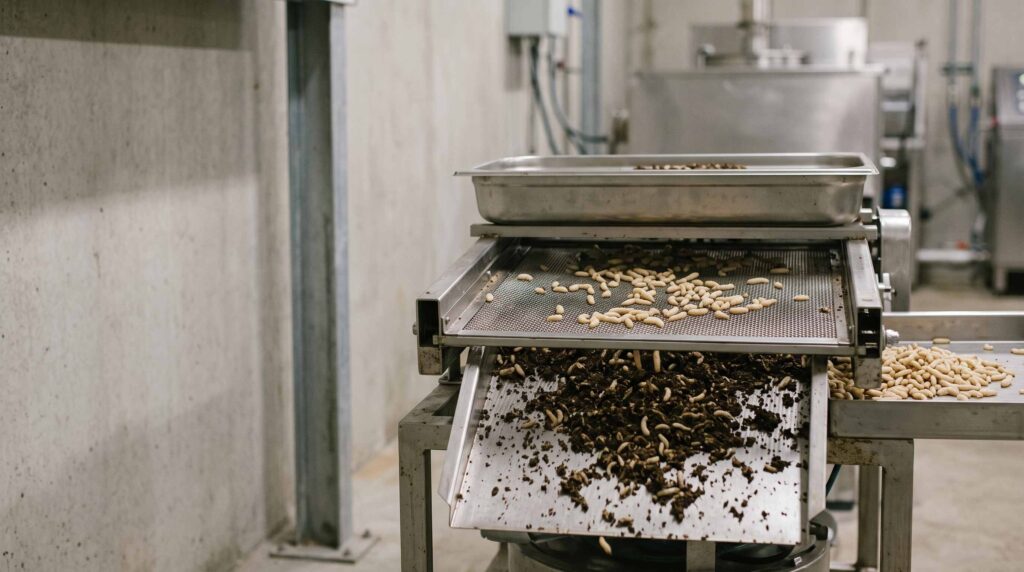
At harvest, larvae must be separated from the remaining substrate. Screening or sieving can provide a mechanical separation route, while other systems may use differences in larval behavior or physical properties to assist collection. The appropriate method depends on substrate characteristics, production scale, and the level of cleanliness required for the intended product.
Once separated, larvae may require cleaning before further processing. This stage represents the transition from biological production to ingredient manufacturing, and inadequate separation can carry unwanted substrate material into later processing steps.
Commercial systems, therefore, need to evaluate harvesting efficiency together with product cleanliness. A method that recovers a high proportion of larvae but requires extensive downstream cleaning may not provide the best overall production economics.
7. Stabilization and Drying Create a Storable Product
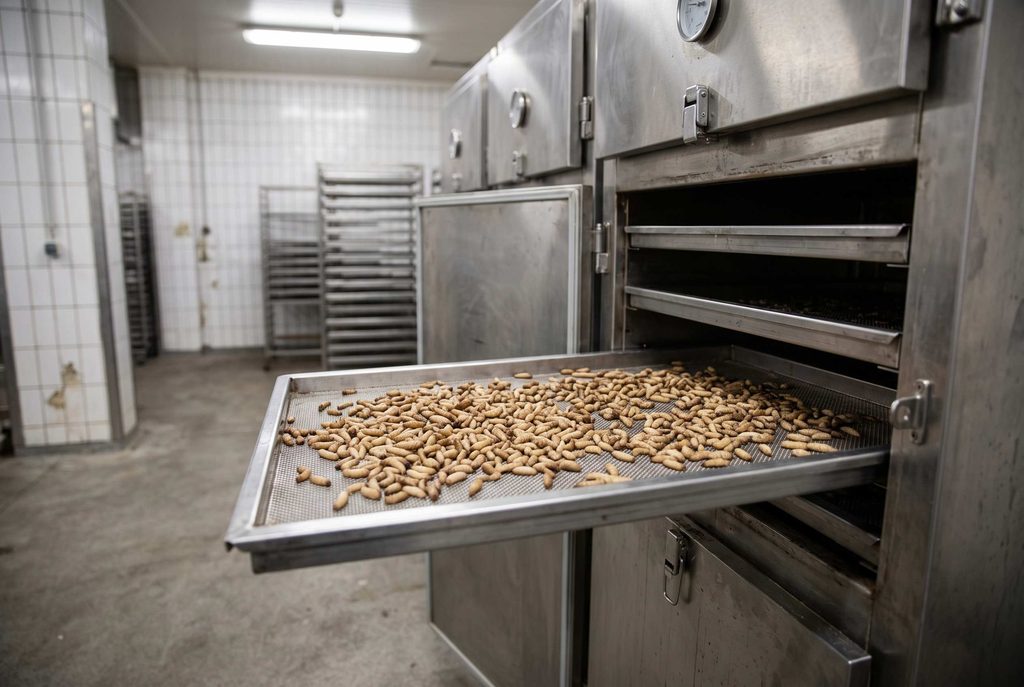
Freshly harvested larvae contain substantial moisture and are biologically unstable. Processing must therefore begin soon after harvesting when the intended output is a stored or traded ingredient. Depending on the production system, post-harvest steps can include washing, thermal treatment, freezing, and drying before the product enters further processing or storage.
Drying is particularly important because it reduces moisture and converts fresh biomass into a more stable commercial format. Research on housefly larvae has evaluated sun drying, oven drying, roasting, and freeze-drying, among other approaches. Different drying conditions can affect physical appearance, nutritional composition, and processing cost, so the choice of technology should reflect the target product rather than simply the fastest available method.
At a commercial scale, drying also becomes an important capacity and energy consideration. A rearing system can produce larvae faster than a poorly sized dryer can process them. Effective production design must therefore balance biological throughput with post-harvest capacity.
8. Processing Determines the Final Commercial Format
The production chain can end with different commercial products. Dried whole larvae represent a relatively limited-processing format, while grinding converts dried biomass into a meal that can be incorporated more easily into formulated feed. Additional processing can separate lipid fractions or create more concentrated protein-rich ingredients.
Each additional step changes the production boundary. Whole dried larvae require stabilization and moisture control; meal adds grinding and particle-size management; defatted ingredients require additional separation and processing. More processing can broaden the range of potential applications, but it also increases equipment requirements, energy consumption, and quality-control complexity.
The appropriate production model, therefore, depends on the target buyer. A facility designed to produce a standardized feed ingredient may require a different processing line from one focused on dried whole larvae or resource-recovery applications.
9. Quality and Biosecurity Must Run Through the Entire System
Housefly production requires particularly clear biosecurity boundaries because Musca domestica is also widely recognized as a potential vector of microorganisms in uncontrolled environments. Commercial production must distinguish a managed production colony from the environmental conditions normally associated with wild houseflies.
Biosecurity begins with facility design and continues through substrate handling, colony containment, hygiene, harvesting, cleaning, and processing. Monitoring becomes more important as scale increases because a biological or microbiological problem can affect multiple production batches rather than a single tray.
Quality control must follow the same chain. Substrate records, batch identification, processing conditions, moisture, microbiological parameters, and storage conditions can all contribute to the final commercial specification. For feed-oriented production, the buyer ultimately purchases a controlled ingredient, not merely insect biomass.
10. Scaling Requires Control Across the Production Chain
Commercial scale changes the production problem. Increasing the number of larvae without improving material handling, egg distribution, harvesting, drying, and quality control can create more variability rather than more usable output. Scaling, therefore, requires coordination between biological production and industrial processing.
Automation can become increasingly relevant in repetitive operations such as substrate preparation, dosing, tray handling, separation, and processing. The objective is not automation for its own sake, but greater control over labor requirements, throughput, and batch consistency. Production systems also need enough flexibility to manage biological variation without disrupting the entire facility.
The most useful way to view commercial housefly larvae production is therefore as an integrated chain:
Weakness at any point can constrain the output of the entire system. A highly productive larval stage has limited commercial value if the resulting biomass cannot be harvested efficiently, processed safely, or released with a consistent specification.
IIR Analysis
Housefly larvae production has a strong biological foundation, but biological efficiency alone does not determine commercial viability. Recent research confirms that substrate composition, environmental conditions, and stocking density can materially affect larval growth, yield, and conversion performance, while processing choices influence the characteristics of the final ingredient. The commercial task is therefore to control variation from the breeding colony through to the finished product.
The industry’s production challenge is also different from simply maximizing biomass. Housefly larvae are attractive partly because they can utilize low-value organic streams, but this advantage increases the importance of substrate control, biosecurity, and downstream quality assurance. Successful commercial production will depend on converting that flexible biology into a standardized manufacturing process capable of producing repeatable, saleable output.
Disclaimer: This article is for informational purposes only and does not constitute business, legal or investment advice. Always consult primary sources and qualified professionals.