Independent intelligence for the global insect industryISSUE 01 · 2026
Grasshopper Supply Chain: From Rearing to Ingredient Distribution
By IIR Editorial DeskSeptember 30, 2026
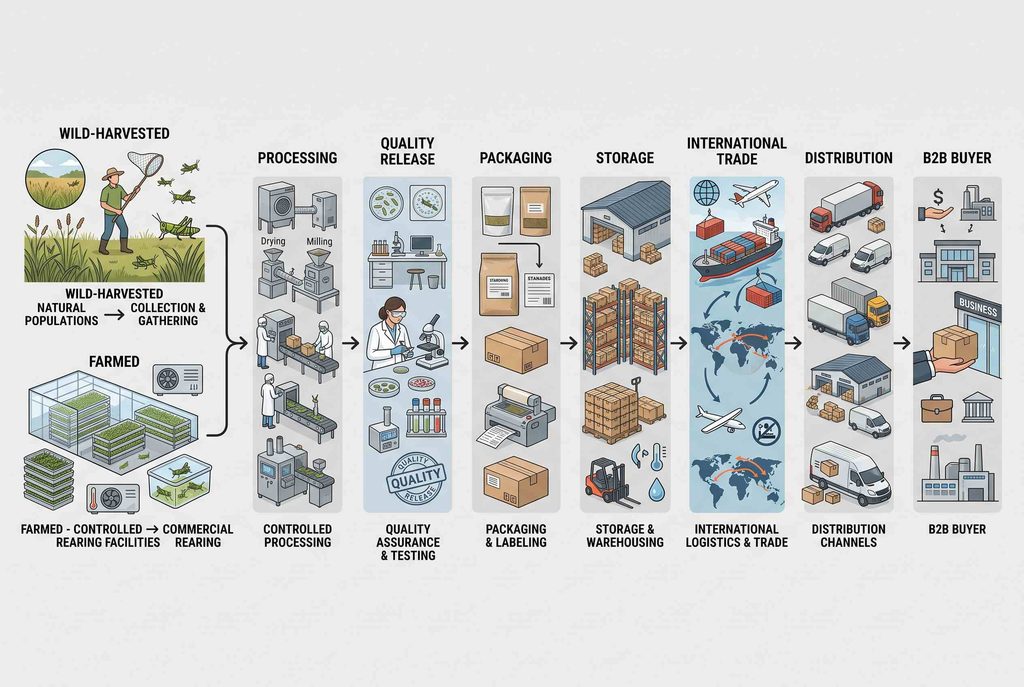
The grasshopper supply chain connects farmed and harvested insects with processing, quality control, storage, international trade and B2B distribution. This analysis examines how source, traceability and product form affect commercial supply.
This analysis examines how commercial grasshopper products move from farming or harvesting through processing, quality release, storage, international trade and B2B distribution.
By IIR Editorial Desk · September 30, 2026 · Market Intelligence
The commercial grasshopper supply chain begins before insects enter a processing facility. Species, production origin, and harvesting conditions can influence whether the resulting material is suitable for a particular food, feed, or specialty market.
This makes the sector different from insect supply chains built primarily around controlled farming. Grasshopper and locust products can originate from farmed populations, smaller controlled operations, or wild harvesting, and these routes do not provide the same level of traceability or control over environmental exposure.
Once harvested, the insects still need to move through stabilization, drying, processing, quality release, packaging, storage, and distribution. Supply-chain performance, therefore, depends on more than having insects available; it depends on converting them into a defined product that can reach the intended buyer with the required quality and documentation.
1. The Supply Chain Starts With Species and Source
The first commercial question is not simply whether a supplier has grasshoppers available. Buyers need to understand what species is being supplied and where the insects originated.
This distinction matters because grasshopper and locust species are not commercially interchangeable. Product characteristics, production methods, and regulatory status can differ, particularly when products are intended for human food or cross-border trade.
The source is equally important. Farmed insects can be raised under controlled feeding and environmental conditions, while wild-harvested insects are exposed to conditions that the supplier may not fully control. A commercial supply chain needs enough source information to determine whether the material is appropriate for the intended application.
2. Farmed and Wild-Harvested Supply Follow Different Routes
Controlled farming creates a relatively structured upstream chain. Breeding, feed, rearing conditions, and harvesting can be planned, allowing production batches to move into processing according to a defined schedule.
Wild harvesting follows a different pattern. Availability can depend on season, geography, and insect populations, making supply less predictable. Collection may involve manual catching, stationary traps, or mobile trapping systems, depending on local conditions.
These models should not automatically be combined into one undifferentiated supply pool. Farmed and harvested material can have different histories, risk profiles, and documentation, even when the finished insects appear physically similar.
For distributors and industrial buyers, source classification is therefore part of procurement rather than a minor production detail.
3. Pesticide Exposure Is a Critical Sourcing Risk
Wild-harvested grasshoppers and locusts create a sourcing issue that is less prominent in many controlled insect-farming systems: possible exposure to agricultural pesticides.
Because grasshoppers and locusts can be agricultural pests, populations may have been treated with insecticides by farmers or government control programs. Feed and food guidance has documented cases in which pesticide residues were detected in harvested locusts and warns against collecting insects for consumption from areas where pesticides have been applied.
This changes the commercial meaning of traceability. Knowing the geographic source of wild insects is not enough; buyers may also need information about pest-control activity and chemical exposure.
A large seasonal harvest is therefore not automatically equivalent to commercially usable supply. Material that cannot meet the safety requirements of the intended market may have little value in a formal food or feed supply chain.
4. Harvesting and Processing Create the First Quality Gateway
After farming or collection, insects need to move into controlled post-harvest handling. Foreign material, production residues, and unsuitable insects may need to be removed before stabilization or drying.
Processing requirements depend partly on product form. Whole dried grasshoppers place greater emphasis on physical integrity, cleanliness, and appearance, while material intended for grinding can tolerate more breakage.
Stabilization and drying then change the logistics of the product. Removing moisture can make grasshoppers easier to store and transport, but the process must ensure appropriate product stability without unnecessarily reducing quality or saleable yield.
At this point, the supply chain begins to move from biological material toward a standardized commercial product.
5. Product Form Determines the Downstream Supply Chain
A whole dried grasshopper and a ground grasshopper ingredient can originate from the same biological source but move through different commercial channels.
Whole products may require sorting, careful handling, and packaging designed to limit breakage. Physical appearance remains visible to distributors and customers, making integrity part of commercial quality.
Ground products shift attention toward processing consistency, particle size, and compositional specifications. Additional processing can make the material suitable for manufacturers that would not purchase recognizable whole insects.
The supply chain therefore branches according to product form:
The final market determines which specifications and logistics requirements matter most.
6. Quality Release Converts Inventory Into Saleable Supply
Finished processing does not necessarily mean that a batch is ready for commercial distribution. Formal buyers may require specifications, batch identification, analytical results or other quality documentation before accepting the product.
Testing requirements depend on source, product type, application, and destination market. Microbiological parameters, chemical contaminants, and pesticide residues can become relevant, particularly where source conditions create additional uncertainty.
This creates an important distinction between finished inventory and commercially released inventory. Material can physically exist in a warehouse while remaining unavailable for sale because testing or documentation has not been completed.
Quality release is therefore a supply-chain gateway rather than an administrative step at the end of production.
7. Packaging and Storage Protect the Value Created Upstream
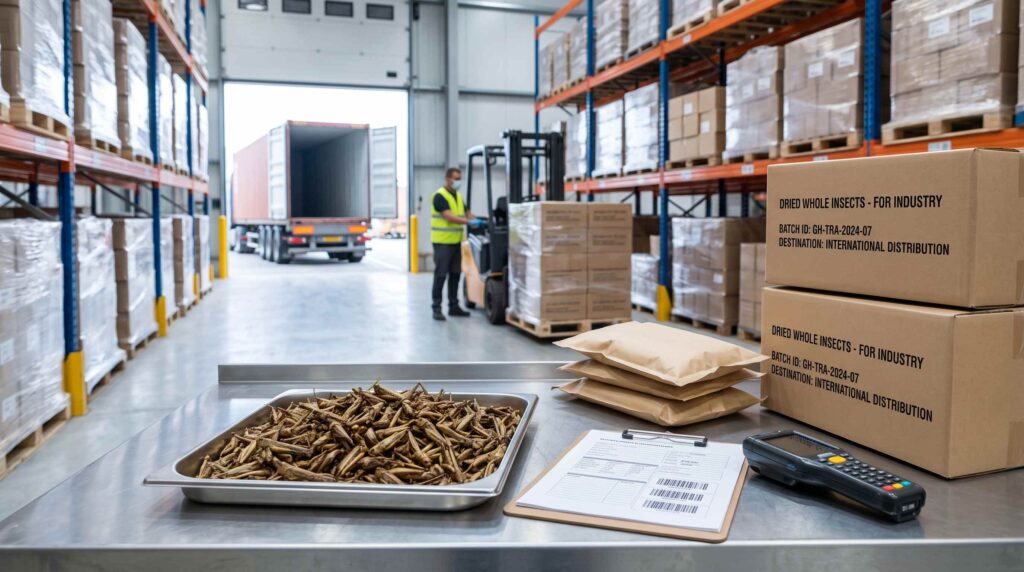
Packaging needs to preserve the condition established during processing. Whole dried grasshoppers can be vulnerable to crushing and breakage, while dried products generally need protection from moisture and unsuitable storage conditions.
Storage failures can reverse some of the value created during drying. Feedipedia notes that inappropriate post-harvest storage, including moist or contaminated conditions, can contribute to fungal growth and potential mycotoxin risks.
Commercial packaging also affects logistics. Bag or carton dimensions, pallet configuration, and shipment size influence warehouse handling and freight efficiency. Packaging, therefore, sits at the intersection of product protection and distribution economics.
For B2B buyers, appropriate packaging is not simply cosmetic. It helps maintain the physical and quality characteristics of the product until the next participant in the chain receives it.
8. Traceability Becomes More Important as the Chain Expands
A local transaction can involve a relatively short path between producer and buyer. International trade can add processors, exporters, freight providers, importers, warehouses, and distributors.
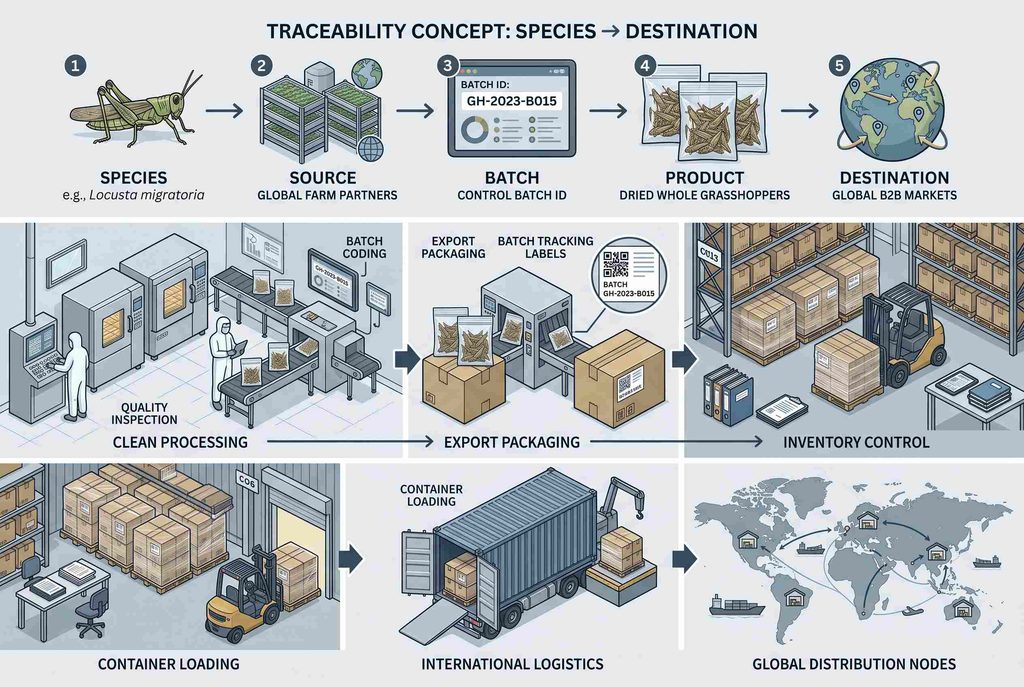
Every additional participant increases the importance of maintaining product identity. Batch information should remain connected with source, processing, and quality records as products move between organizations.
This is particularly important when farmed and wild-harvested supplies coexist. Without adequate traceability, downstream buyers can have difficulty determining the production history associated with a particular batch.
Traceability also limits the commercial impact of quality problems. When batches can be identified accurately, companies can investigate or isolate affected material without automatically disrupting unrelated inventory.
9. International Trade Adds Species- and Market-Specific Requirements
Cross-border trade adds regulatory requirements that domestic transactions may not face. Product classification, food or feed rules, customs procedures, documentation, and market access can determine whether a shipment can legally enter its destination.
Species identification becomes especially important. In the European Union, frozen, dried, and powder forms of Locusta migratoria are included in the authorized Novel Food framework under defined conditions. That authorization applies to the specified novel food; it should not be interpreted as blanket market access for every grasshopper species or every application.
The regulatory situation can also change over time. In July 2026, the European Commission terminated a procedure seeking a change to the conditions of use for frozen, dried, and powder forms of Locusta migratoria without updating the Union list, reinforcing the importance of checking the current authorization rather than assuming that proposed changes have taken effect.
International buyers, therefore, need to evaluate the exact combination of species + product form + intended use + destination market.
10. Importers and Distributors Aggregate Fragmented Demand
Not every commercial buyer needs quantities large enough to purchase directly from a producer or overseas processor. Specialty-food companies, animal-nutrition businesses, and smaller manufacturers may require more modest volumes.
Importers and distributors can bridge this gap by consolidating larger shipments, holding local inventory and supplying smaller quantities to multiple customers. They can also shorten delivery times and provide a local commercial interface between overseas producers and domestic buyers.
This intermediary layer becomes especially useful when production is geographically concentrated, but demand is dispersed across many smaller customers.
Distribution, therefore, does more than move the product. It converts large upstream supply into purchasing quantities and delivery schedules that fit the structure of downstream demand.
11. Supply Reliability Depends on the Entire Chain
Production capacity alone does not determine how much product a buyer can actually receive. Supply can be constrained by seasonal harvesting, farming output, processing throughput, testing, packaging availability, warehouse capacity, or international logistics.
Wild supply adds another source of variability because insect availability can be irregular. Feedipedia notes that locust infestations are intermittent and short-lived, limiting their reliability as a regular feed resource unless more stable supply systems are developed.
Controlled farming can improve predictability, but only if downstream stages can handle the resulting output. Expanding rearing capacity provides limited commercial benefit when drying, quality release, or logistics become the bottleneck.
For buyers, deliverable supply is therefore more meaningful than theoretical production or harvesting potential.
12. A Commercial Supply Chain Must Move Product and Information Together
The strongest grasshopper supply chains move more than physical insects. Species identity, source information, batch records, quality documentation, and destination requirements need to travel with the product.
This is especially important when the chain crosses borders. A shipment can be physically ready for export while remaining commercially unusable if documentation, specifications, or market-access requirements are incomplete.
At every stage, physical product and supporting information need to remain aligned. Breakdowns in either can interrupt commercial delivery.
IIR Analysis
The grasshopper supply chain is defined by an upstream sourcing challenge that distinguishes it from many other commercial insect sectors. Farmed and wild-harvested insects can both enter the wider market, but they do not provide equivalent control over feed history, environmental exposure, traceability, or availability.
Pesticide exposure makes this distinction commercially significant. Wild insects collected from agricultural areas cannot be assumed to be suitable for food or feed simply because large quantities are available. Source verification and appropriate quality controls can determine whether harvested biomass becomes usable commercial inventory at all.
Species identity becomes equally important when products enter international trade. The EU authorization of defined Locusta migratoria products demonstrates why a generic label such as “grasshopper” is insufficient for evaluating market access.
For IIR, supply-chain strength should therefore be measured by more than the amount of biomass moving through the system. The more meaningful indicator is whether suppliers can repeatedly convert a known source and species into a quality-released, traceable and deliverable commercial product that meets the requirements of its destination market.
Disclaimer: This article is for informational purposes only and does not constitute business, legal or investment advice. Always consult primary sources and qualified professionals.