Independent intelligence for the global insect industryISSUE 01 · 2026
Cricket Supply Chain: From Rearing to Ingredient Distribution
By IIR Editorial DeskSeptember 28, 2026
The cricket supply chain connects commercial rearing and processing with quality control, packaging, storage, international logistics and ingredient distribution. This analysis examines how cricket products move from producers to commercial buyers.
This analysis examines how commercial cricket products move through the supply chain, from rearing and processing to quality release, storage, international trade and B2B distribution.
By IIR Editorial Desk · September 28, 2026 · Market Intelligence
The Cricket Supply Chain Extends Beyond the Farm
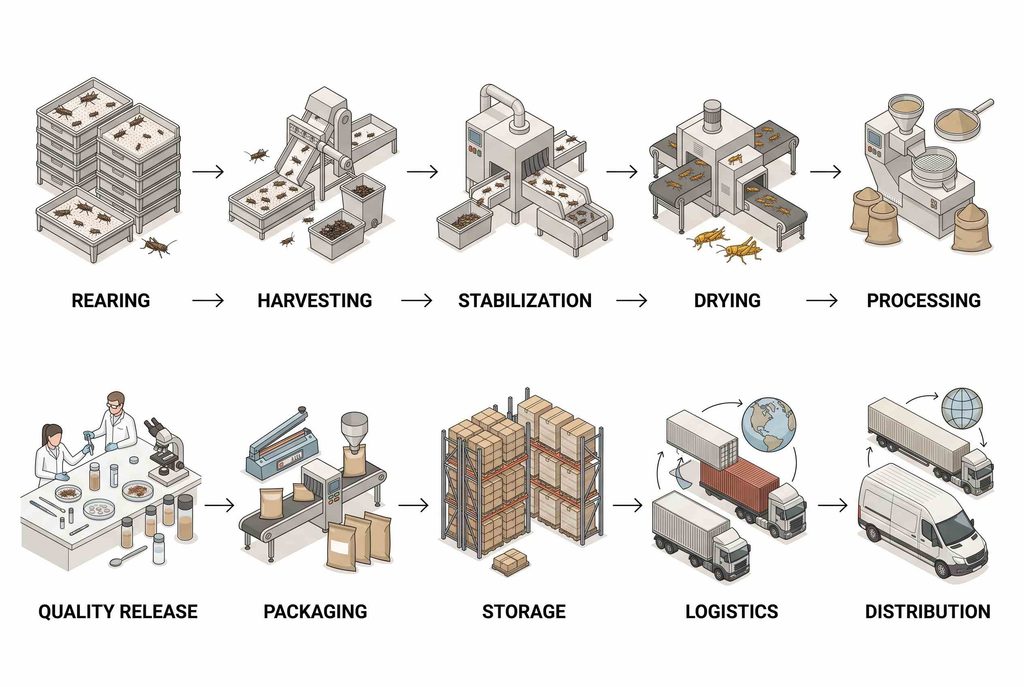
The commercial cricket supply chain begins with insect production, but it does not end when crickets are harvested. Between the farm and the final buyer, products may pass through stabilization, drying, milling, quality testing, packaging, storage, freight, import procedures, and local distribution.
Each stage can influence the commercial value of the product. A farm may produce consistent cricket biomass, yet buyers can still face problems if processing is inconsistent, packaging fails to protect the product, documentation is incomplete, or international shipments encounter regulatory barriers.
This makes supply-chain performance different from production performance. Production determines whether cricket biomass can be generated efficiently. The supply chain determines whether that biomass can be converted into a defined commercial product and delivered to the intended customer in the required condition.
1. Rearing Creates the Biological Supply Base
Commercial rearing provides the biological foundation of the supply chain. Breeding performance, feed management, environmental control, biosecurity, and survival all influence how much harvestable biomass becomes available for downstream processing.
Consistency matters because industrial customers usually purchase products according to specifications rather than simply buying insects as undifferentiated biomass. Large variations between production cycles can create problems later when processors or distributors need predictable moisture levels, particle sizes, microbiological characteristics, or physical appearance.
Supply-chain reliability starts with repeatable production. Without that foundation, downstream inventory planning and customer commitments become more difficult even when a farm has substantial theoretical capacity.
2. Harvesting Connects Farming With Industrial Processing
Harvesting is the point at which live biological production begins to enter an industrial processing system. Crickets must be collected and separated from feed residues, waste and other rearing materials before further treatment.
Handling at this stage can affect the final product. Buyers purchasing whole dried crickets may place value on physical integrity and appearance, while producers supplying powder or processed ingredients may prioritize throughput and processing efficiency.
Timing also matters. Once harvested, cricket biomass is perishable and must move into an appropriate stabilization process. Delays between harvesting and processing can complicate microbial control and product consistency.
3. Stabilization Reduces Post-Harvest Risk
Freshly harvested crickets cannot simply move into long-term storage. Post-harvest treatment is needed to stabilize the biomass and prepare it for drying, freezing or another preservation process.
Thermal treatment can play an important role in microbial control. Research on edible insects, including house crickets, has shown that processing conditions influence microbiological quality and that preservation strategy matters for subsequent shelf stability. 科学直达
For commercial operators, stabilization needs to be treated as part of the supply chain rather than as a minor step between farming and drying. Inconsistent treatment can affect product safety, processing performance and the reliability of the finished ingredient.
4. Drying Creates a More Tradable Product
Drying changes the logistics of cricket products by removing a substantial portion of their water. The resulting product is generally easier to store and transport than fresh biomass and can serve either as a finished whole-cricket product or as an intermediate material for milling.
Processing method can also affect the finished product. Recent research comparing oven, vacuum and freeze drying of Acheta domesticus found differences in characteristics including water activity, color, oxidation and functional properties, even when final moisture levels were comparable. 科学直达
The supply-chain implication is important: “dried cricket” is not necessarily a uniform commercial category. Processing technology and process control can influence what downstream buyers actually receive.
5. Processing Creates Different Commercial Product Streams
After stabilization and drying, cricket biomass can move into several commercial forms. The simplest route is whole dried crickets, while additional processing can create powders or more specialized ingredients.
These product forms do not move through identical supply chains. Whole crickets may require greater attention to appearance, breakage, and packaging protection. Powders introduce milling consistency and particle-size considerations. More extensively processed ingredients can require additional specifications and quality controls.
A single production facility can therefore feed several downstream markets, but each product stream may develop its own handling, packaging, and distribution requirements.
6. Product Specifications Become the Commercial Language of the Chain
Once cricket products move from one producer to another, specifications become essential. Buyers need a practical way to define what they are purchasing and determine whether the delivered material meets their requirements.
Depending on the product and intended application, specifications may address moisture, protein, fat, microbiological parameters, particle size, physical integrity, or other characteristics. Requirements can also differ substantially between whole dried products, powders, and ingredients intended for further manufacturing.
Clear specifications reduce ambiguity between producers, exporters, importers, and buyers. They also provide a reference point for quality release and commercial claims when products change hands.
7. Quality Release Is a Commercial Gateway
Finished product is not automatically saleable simply because processing has ended. Commercial batches may need to pass internal quality checks or laboratory testing before they are released for shipment.
The scope of testing depends on product type, customer requirements, destination market, and applicable regulation. Documentation may include batch identification, analytical results, and other records needed by buyers or regulatory authorities.
This creates an important distinction between physical inventory and released inventory. A warehouse may contain finished cricket products that cannot yet move into commercial distribution because quality documentation or release procedures remain incomplete.
8. Packaging Protects Product During Distribution
Packaging becomes part of product performance once crickets leave the processing facility. It must protect the contents during storage, handling, and transportation while remaining suitable for the intended commercial format.
Whole dried crickets can be vulnerable to physical damage, making breakage and compression relevant considerations. Powders create different requirements, including containment and protection against environmental moisture.
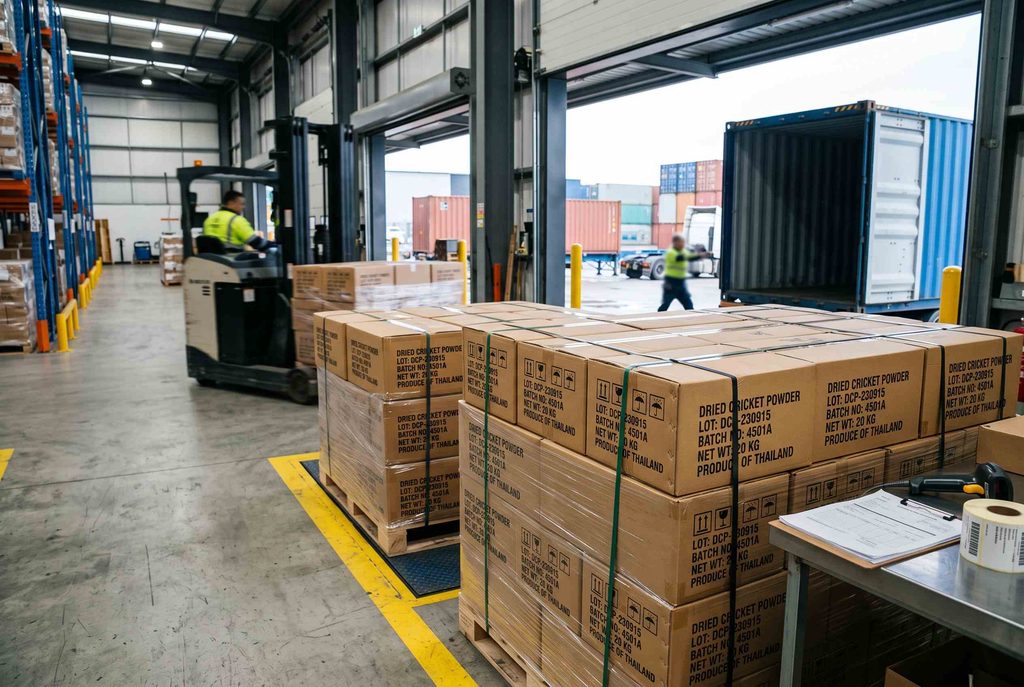
Packaging decisions also affect logistics. Bag size, carton dimensions, pallet configuration, and labeling influence warehouse handling, freight efficiency, and the way distributors divide larger commercial quantities into smaller orders.
Dried cricket products remain sensitive to their storage environment. Moisture exposure and temperature can affect product stability, particularly when products are stored for extended periods or transported through warm climates.
Research on dried and pulverized Acheta domesticus demonstrates the importance of moisture control, packaging and storage temperature. In one study, estimated shelf life changed substantially with storage temperature, illustrating why drying alone does not guarantee stability throughout distribution. 科学直达
Warehousing is therefore an active part of the supply chain. Appropriate packaging and storage conditions help preserve the condition established during processing until the product reaches the next commercial user.
10. Inventory Management Connects Production With Customer Demand
Insect production follows biological cycles, while commercial orders follow customer purchasing patterns. Those two timelines do not always match.
Inventory provides a buffer between production and demand. Finished products can be stored until customers place orders, allowing producers and distributors to serve buyers without requiring each shipment to correspond directly to a new production cycle.
Excessive inventory creates its own costs and risks. Warehousing ties up working capital, consumes storage space and extends the time during which product quality must be maintained. Effective inventory management balances availability with realistic sales velocity.
11. Logistics Can Change the Economics of Cricket Products
Freight becomes increasingly important as cricket products move beyond local markets. Transport cost depends on distance, shipment size, product form, packaging efficiency, and the mode of transportation.
Dry products have an advantage over fresh biomass because much of the water has already been removed. Even so, low-volume shipments can carry relatively high freight costs per kilogram, particularly when buyers require international air transport or frequent small deliveries.
Larger shipments can improve freight efficiency but require sufficient demand, inventory, and working capital. The most economical logistics model, therefore, depends partly on the scale and purchasing behavior of the customer base.
12. International Trade Adds Regulatory Complexity
Cross-border distribution introduces requirements that may not exist in domestic transactions. Product classification, import documentation, food or feed rules, customs procedures, and destination-specific market access can all affect whether a cricket product can be legally sold.
The regulatory position also depends on product form and intended use. In the European Union, for example, the Union list includes authorized forms of Acheta domesticus, including frozen, dried, and powder forms, as well as partially defatted powder under specific authorizations. Authorized novel foods are subject to defined specifications, conditions of use, and labeling requirements.
Market access should therefore be evaluated for the specific product, application, and destination, rather than assuming that approval of one cricket-derived product automatically applies to every form or use.
13. Importers and Distributors Connect Producers With Fragmented Demand
Not every commercial buyer needs a full container or a large direct order from a producer. Smaller food businesses, specialty-feed companies, pet-product brands, and other customers may purchase quantities that are inefficient for an overseas producer to supply individually.
Importers and distributors can aggregate demand, hold local inventory, and divide larger shipments into quantities that better match customer purchasing patterns. They may also provide local sales, documentation support, and shorter delivery times.
This intermediary layer can be especially important when production is concentrated in one region while demand is distributed across multiple countries or smaller commercial customers.
14. Traceability Becomes More Important as the Chain Expands
A short supply chain may involve only a producer and a buyer. International distribution can involve processors, exporters, freight companies, importers, warehouses, and distributors before the product reaches the final commercial user.
As the number of participants increases, traceability becomes more important. Batch identification helps connect finished products with production, processing, and quality records as material moves through different organizations.
Traceability is also useful when problems occur. If a quality issue affects a specific batch, accurate records can help identify the relevant inventory without unnecessarily disrupting unrelated products.
15. Supply Reliability Matters More Than Theoretical Capacity
Large announced capacity does not guarantee a reliable supply. Buyers ultimately depend on the quantity of product that can be produced, processed, quality-released, and delivered consistently.
A facility can experience strong biological output but still face bottlenecks in drying, testing, packaging, or logistics. In other cases, processing capacity may be available while production volumes remain below expectations.
Commercial buyers are therefore more exposed to deliverable supply than nameplate capacity. Consistency across the entire chain can be more valuable than a large theoretical production figure that does not translate into predictable shipments.
16. Supply Chain Bottlenecks Can Appear at Multiple Stages
The cricket supply chain contains several potential constraints. Biological production can limit raw material availability, while processing equipment can restrict the amount of biomass converted into finished products.
Testing laboratories, packaging materials, warehouse capacity, and transportation can create additional bottlenecks. International shipments may also be delayed by documentation or import procedures, even when the physical product is ready.
The effective capacity of the supply chain is determined by its most restrictive stages. Expanding farming capacity alone does not solve a bottleneck located further downstream.
17. Product Form Determines the Distribution Model
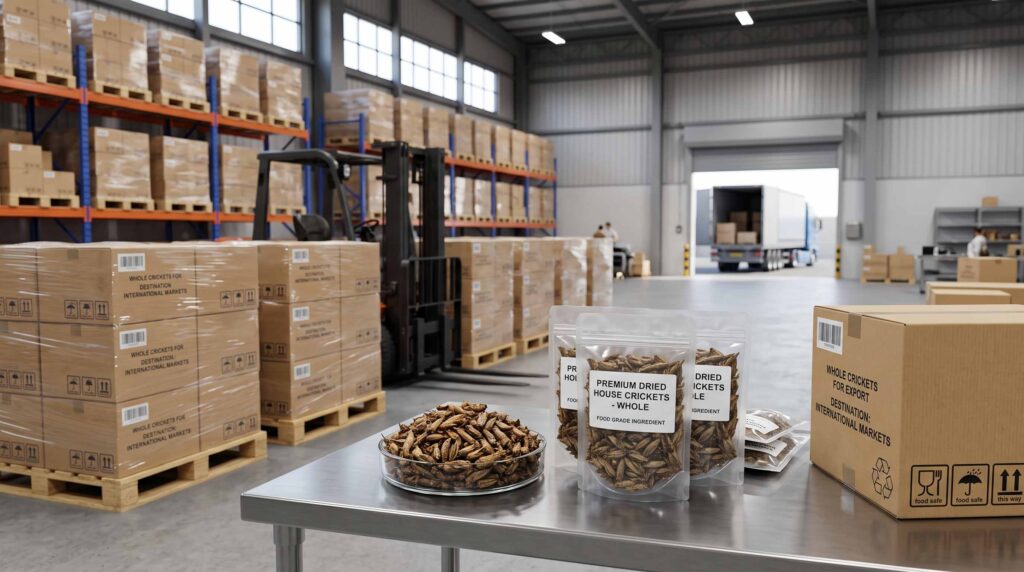
Different cricket products naturally support different distribution structures. Whole dried crickets can move through specialty animal-food, retail, or ingredient channels, depending on the market. Cricket powder can be supplied to manufacturers that incorporate it into formulated products.
More processed ingredients may require closer technical relationships between suppliers and industrial customers. Specifications, minimum order quantities, documentation, and quality requirements can become more demanding as the product moves deeper into food or feed manufacturing.
The commercial route is therefore shaped not only by where crickets are produced, but by what form of cricket product enters the market and who uses it next.
What Makes a Cricket Supply Chain Commercially Resilient?
A resilient supply chain is not simply the shortest route between a farm and a buyer. It needs enough control at each stage to maintain product quality while allowing material, information, and documentation to move together.
Production consistency, processing capacity, quality release, suitable packaging, storage control, and reliable logistics all contribute to that resilience. International trade adds another requirement: suppliers must understand whether the specific product can enter the intended market and under what conditions.
The strongest systems reduce dependence on a single fragile stage. Alternative logistics options, appropriate inventory buffers and clear batch documentation can help companies respond when individual parts of the chain are disrupted.
IIR Analysis
The commercial cricket supply chain should be understood as a conversion process rather than a simple transport route. Biological production creates cricket biomass, but processing converts it into a defined product, quality control makes that product commercially releasable, and logistics connect it with the buyer.
This distinction becomes more important as cricket businesses move beyond local markets. International customers are not buying production capacity; they are buying a specific product that must arrive with the required characteristics, documentation, and regulatory status.
Product form is one of the most important variables in the chain. Whole dried crickets, powders, and more specialized ingredients can originate from the same species but require different processing, packaging, storage, and market-access strategies.
For IIR, the more meaningful measure of supply-chain strength is therefore not how much cricket biomass a farm can theoretically produce. It is how consistently the system can convert that biomass into a released, compliant, and deliverable commercial product.
Disclaimer: This article is for informational purposes only and does not constitute business, legal or investment advice. Always consult primary sources and qualified professionals.