Independent intelligence for the global insect industryISSUE 01 · 2026
Cricket Production Cost: Key Drivers of Commercial Economics
By IIR Editorial DeskSeptember 27, 2026
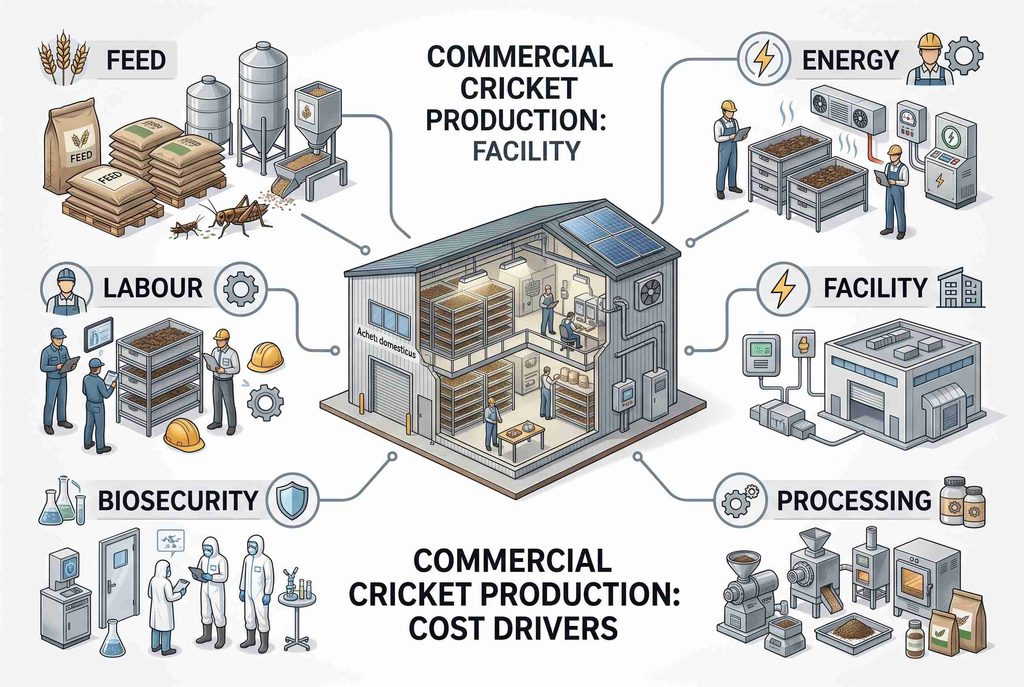
Cricket production economics depend on more than feed prices. Labour, environmental control, survival, processing, facility utilisation and product yield can all influence the cost of commercial output.
This analysis examines the main drivers of commercial cricket production cost, including feed, labour, climate control, biological performance, processing and facility utilisation.
By IIR Editorial Desk · September 27, 2026 · Market Intelligence
Understanding the Economics Behind Commercial Cricket Production
Commercial cricket production cost cannot be reduced to the price of feed or the number of insects housed inside a facility. Cricket farming combines biological production with controlled-environment agriculture, repetitive handling, post-harvest processing and quality management.
The economics also change according to what the farm sells. Fresh crickets, whole dried crickets, and cricket powder have different processing requirements and cost structures. A farm supplying specialty markets can also operate under different pricing conditions from one attempting to compete in larger-volume ingredient markets.
Published commercial cost data remain limited, making universal cost-per-kilogram benchmarks unreliable. A more useful approach is to examine how feed, labor, energy, survival, processing, and facility utilization combine to determine the cost of saleable output. Research into insect-farm economics also shows substantial differences in sales prices by geography, end market, and quantity sold.
1. Feed Is a Major Operating Cost
Feed is one of the most important recurring inputs in commercial cricket farming. Every production cycle requires sufficient nutrition to support growth from early nymph stages through to the target harvest stage.
Economic research on insect farming identifies feed among the major operating costs, while cricket-production research has repeatedly investigated different diets and locally available ingredients. The commercial challenge is that reducing feed price does not necessarily reduce total production cost if the alternative diet also reduces growth, survival, or final biomass.
Feed economics are better evaluated according to the amount of saleable cricket biomass generated from the input, rather than simply the purchase price of the feed itself.
2. Feed Conversion Connects Nutrition With Economics
Feed conversion provides a link between biological performance and financial performance. If more feed is required to produce the same amount of harvestable biomass, feed cost per unit of output increases.
Diet also affects more than feed expenditure. Changes in nutrition can influence growth rate, survival, and final product characteristics. A lower-cost diet can lose its economic advantage if crickets require longer production cycles or generate less usable biomass.
For commercial operators, feed conversion is most meaningful when evaluated alongside growth, survival, and final yield. The objective is not simply to minimize feed input, but to convert that input into predictable commercial output.
3. Labor Can Become a Major Scaling Constraint
Commercial cricket farming involves repeated tasks throughout the production cycle. Breeding management, egg handling, feeding, hydration, cleaning, movement of production units, harvesting and facility sanitation can all require labor.
The burden becomes more visible as the number of production units increases. A task that takes only a small amount of time for one container can become expensive when repeated across hundreds or thousands of units.
Economic research into insect farms identifies feed and labor among the important operational costs. For cricket producers, labor efficiency is closely connected to facility design, workflow, and the level of automation.
4. Automation Can Reduce Manual Work but Adds Capital Cost
Automation can reduce the manual work required for feeding, monitoring, material movement, harvesting, and other repetitive operations. The potential benefit increases as farms expand and the same tasks must be performed across larger production populations.
Equipment introduces another set of costs. Capital expenditure, maintenance, depreciation, and technical support need to be absorbed by the output of the facility. An automated system operating below its intended throughput can carry substantial fixed costs without producing enough finished product to distribute those costs efficiently.
The economic case for automation depends on actual production conditions. Labor savings, consistency, and higher throughput need to justify the capital and operating costs at the scale the farm can realistically maintain.
5. Climate Control Can Be a Significant Energy Requirement
Crickets are ectothermic, making environmental temperature directly relevant to development and production performance. Commercial farms operating outside suitable natural conditions may require heating, cooling, or both.
Geography can consequently affect production economics. A facility operating in a naturally warm climate can have different environmental-control requirements from an enclosed farm operating through a cold winter. Building insulation, production density, and local energy prices add further variation.
Energy expenditure also needs to be considered alongside biological performance. Lowering climate-control costs has limited value if the resulting conditions extend production cycles, reduce survival, or lower annual facility throughput.
6. Ventilation and Humidity Management Add to Facility Costs
Temperature is only one component of the production environment. Dense cricket populations generate heat and moisture, while waste and feed residues also affect conditions inside production areas.
Ventilation, sensors, and humidity-control systems require infrastructure and electricity. Their operating requirements vary with building design, climate, production density, and the type of rearing system.
These systems support more than environmental comfort. Stable conditions can help maintain predictable production, making environmental control part of the facility’s biological-performance system as well as its cost structure.
7. Survival Rate Has a Direct Economic Effect
A cricket farm incurs feed, labor, energy, and facility costs before the final harvest occurs. When mortality increases during the production cycle, part of those accumulated inputs produces no saleable output.
Survival is consequently an economic variable as well as a biological performance measure. Two facilities using similar amounts of feed, labor, and physical infrastructure can produce different unit costs if one consistently converts a larger proportion of its population into harvestable biomass.
At an industrial scale, even relatively small changes in survival can affect the amount of finished product over which fixed and variable costs are distributed.
8. Disease Can Disrupt the Economics of an Entire Production Cycle
Disease risk gives cricket economics a particularly important biological dimension. Commercial house-cricket production has experienced viral disease outbreaks capable of sharply reducing expected output. A 2025 study conducted on a U.S. commercial cricket farm specifically examined three important viral pathogens and noted that viral outbreaks have affected production and profit margins.
The immediate economic effect is lost biomass, but the consequences can extend further. Sanitation, disposal, interruption of production cycles, replacement of breeding stock, and underutilization of rearing or processing infrastructure can all add costs.
Biosecurity has economic value even though it does not directly create saleable product. Hygiene, separation of production groups, monitoring, and controlled movement of equipment or personnel can help reduce the risk that a biological disruption affects a much larger share of expected output.
9. Production Cycle Length Influences Facility Throughput
A rearing facility has limited physical capacity. The amount of time each production cohort occupies that capacity affects how many cycles the facility can complete over a year.
Faster growth is not automatically better if it comes at the expense of survival or product quality. At the same time, unnecessarily long production cycles can reduce annual throughput and extend the period over which environmental-control and facility costs accumulate.
Commercial performance depends on the combination of growth rate, survival, and harvestable yield, rather than any single biological metric.
10. Production Density Changes the Economics of Space
Higher stocking density can increase the amount of biological production attempted within a given building. In principle, this allows rent, construction, and environmental-control infrastructure to be spread across greater output.
Density also has operational limits. Feed access, ventilation, waste management, temperature distribution, and disease management can become more difficult as populations intensify.
The more useful economic measure is saleable output per unit of productive space after mortality, processing losses, and quality requirements are taken into account.
11. Harvesting and Handling Add Costs Before Processing Begins
Once crickets reach the target harvest stage, they still need to be separated from rearing materials and transferred into post-harvest treatment. These activities can create significant handling requirements in systems that rely heavily on manual work.
Facility design affects this cost. Production systems built around efficient movement and separation can reduce repetitive handling, while poorly integrated layouts can create additional labor between rearing and processing areas.
Product form matters as well. Whole-cricket markets can place greater emphasis on physical integrity, which may limit handling methods that increase breakage even if they improve processing speed.
12. Drying Can Be a Material Post-Harvest Cost
Fresh crickets contain substantial moisture and require stabilization before long-term storage or distribution as dried products. Removing that water requires processing equipment, time, and energy.
Drying technologies do not have identical operating requirements or product outcomes. Oven drying, vacuum drying, and freeze-drying can differ in equipment intensity, energy use, and their effects on finished ingredients. Recent processing research also shows that drying strategy can affect energy consumption, microbial load, and protein properties in house-cricket flour.
The economic comparison should therefore be made against saleable dried output, not fresh harvested biomass. A kilogram of fresh crickets and a kilogram of finished dried product represent different stages of the production system.
13. Milling and Further Processing Expand the Cost Base
A producer selling whole dried crickets can stop after stabilization, drying, sorting, and packaging. Cricket powder requires additional milling, while more specialized ingredients may involve further processing or separation.
Every additional stage can introduce equipment, labor, energy, maintenance, and product losses. Research into commercial cricket processing also demonstrates that processing conditions can alter nutritional and technological properties, so the decision is not simply a matter of adding another machine to the production line.
The commercial justification is access to different customers or higher-value applications. Additional processing makes economic sense only when the resulting product creates enough value to compensate for the additional manufacturing cost.
14. Product Yield Determines How Costs Are Distributed
Not all biological biomass becomes finished saleable product. Mortality occurs before harvest, moisture is removed during drying, and downstream processing can create additional losses or separate the biomass into different fractions.
Yield is therefore central to cost analysis. The relevant question is not only how much it costs to rear a kilogram of fresh crickets, but how much finished commercial product remains after the complete production and processing chain.
A facility with comparatively low input costs can still have weak economics if too little saleable output remains at the end of the system.
15. Facility Utilization Changes Unit Economics
Commercial farms carry costs even when production remains below theoretical capacity. Buildings, environmental-control systems, processing equipment, and other infrastructure need to be financed and maintained regardless of whether they operate at full throughput.
Low utilization spreads those costs across less finished product. Higher utilization can distribute some fixed costs across greater saleable output, provided biological performance and processing throughput remain stable.
Announced production capacity should not be treated as evidence of low production cost. A large facility can have unfavorable economics when biological production, processing throughput, or market demand leaves substantial capacity unused.
16. Scale Can Reduce Some Costs but Increase Operational Complexity
Larger facilities can create opportunities for automation, specialized labor, bulk purchasing, and more efficient use of processing equipment. These factors can support economies of scale.
Scale also increases coordination requirements. Breeding, rearing, environmental control, biosecurity, harvesting, processing, and sales need to expand at compatible rates. A bottleneck in one part of the system can leave expensive capacity idle elsewhere.
The economic benefit of scale depends on integrated throughput, not simply the physical size of the farm.
17. Product Form Determines the Production Cost Boundary
Comparing cricket-production costs requires a clear definition of where the calculation ends. Different products contain different amounts of processing.
A cost figure without a defined product boundary can be misleading. Two analyses can report very different production costs while measuring different products and different stages of the value chain.
18. Market Position Determines What Cost Is Commercially Viable
Production cost cannot be evaluated independently of the market in which the product is sold. Whole dried crickets supplied to specialty animal or food markets operate under different pricing conditions from ingredients attempting to compete in large-volume feed formulations.
Published insect-farm profitability research found substantial variation in sales prices by geographical market, end market, and quantity sold. For A. domesticus specifically, the available economic data were limited, reinforcing the need for caution when turning individual studies into industry-wide cost benchmarks.
A technically efficient producer can remain commercially weak if its cost structure does not match the price level of its target market. Higher production costs may still be viable in applications where customers value product differentiation, specialized functionality or a particular product form.
19. Cricket Production Cost Is a System, Not a Single Input
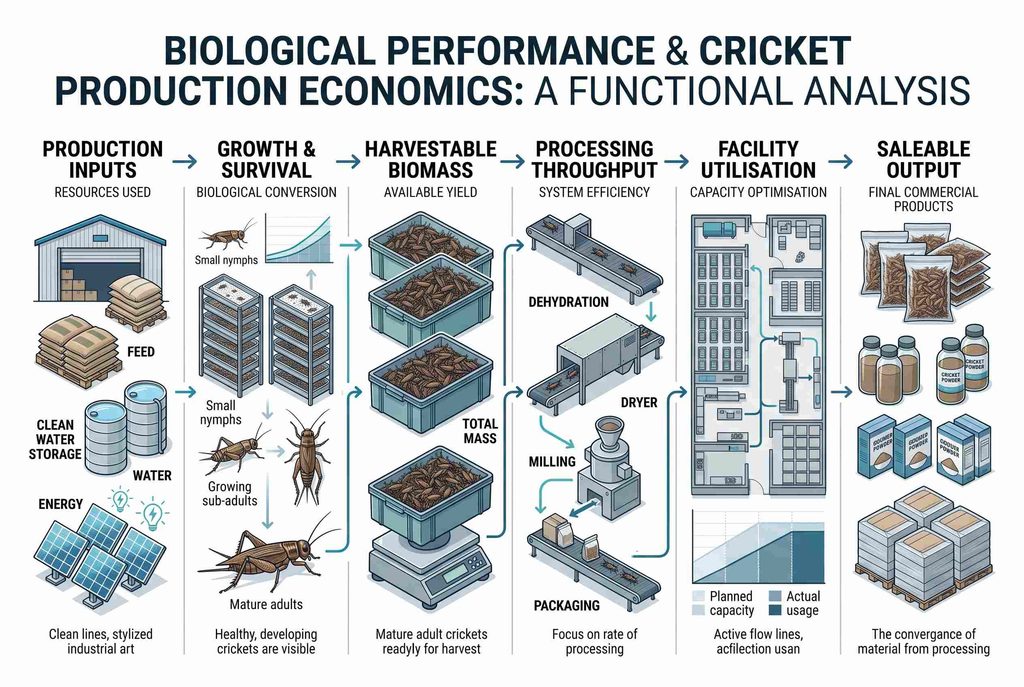
The main economic variables can be summarized conceptually as:
This is an analytical framework rather than a universal accounting formula. Actual businesses also need to account for financing, depreciation, maintenance, quality control, packaging, administration, and other overhead.
The framework helps explain why reducing one input does not automatically improve total output. Cheap feed provides limited benefit when survival falls, while an expensive automated facility can remain inefficient when utilization is low.
IIR Analysis
Commercial cricket production cost is ultimately determined by how efficiently a facility converts biological inputs and infrastructure into saleable products. Feed is important, but its economic effect cannot be separated from labor, environmental control, survival, processing, and facility utilization.
Cricket farming also carries biological risks that conventional manufacturing models can underestimate. Mortality and disease can eliminate biomass after feed, labor, and energy have already been invested, while a major production disruption can leave rearing and processing assets underused. Commercial-farm research on cricket viruses reinforces the importance of treating biological resilience as an economic variable rather than only an animal-health issue.
Scale can improve economics when it raises productive throughput, supports automation, and distributes fixed costs across more finished products. Those benefits weaken when breeding, rearing, processing, or sales fail to keep pace with installed capacity.
For IIR, the more useful indicator of improving cricket economics is not simply cheaper feed or a larger facility. It is the ability to generate more consistent saleable output from the same combination of biological inputs, labor, energy, and infrastructure while maintaining sufficient product value.
Disclaimer: This article is for informational purposes only and does not constitute business, legal or investment advice. Always consult primary sources and qualified professionals.