Independent intelligence for the global insect industryISSUE 01 · 2026
Cricket Industry: Market, Production and Commercial Applications
By IIR Editorial DeskSeptember 26, 2026
This analysis examines the commercial cricket industry, from house cricket farming and processing to market demand, major applications and the constraints shaping industrial-scale production. By IIR Editorial Desk · September…
This analysis examines the commercial cricket industry, from house cricket farming and processing to market demand, major applications and the constraints shaping industrial-scale production.
By IIR Editorial Desk · September 26, 2026 · Market Intelligence
The Cricket Industry Connects Several Different Markets
The cricket industry occupies a distinctive position within the broader insect sector. Crickets have an established history as feeder insects and traditional foods in parts of Asia, while commercial producers have increasingly developed dried whole products, powders and processed ingredients for food and feed applications. FAO documented Thailand as an established commercial insect-farming market more than a decade ago, including organised cricket farming, processing, marketing and trade.
House cricket, Acheta domesticus, is one of the industry’s most important commercial species. A recent review of industrial insect-rearing systems describes it as well suited to mass production because of its relatively consistent life cycle, while also noting its long history of commercial production in the United States. Other cricket species are also commercially relevant, meaning industry analysis needs to distinguish the wider cricket category from any single species.
The resulting market is not one uniform protein industry. Whole crickets, dried crickets, cricket powder, and more processed ingredients can enter different supply chains with different buyers, specifications, regulatory requirements, and price structures.
1. House Cricket Is a Core Commercial Species
Acheta domesticus is widely used in commercial farming and has developed markets in both food and feed. Its relatively predictable production cycle allows reproduction and harvesting to be organised around recurring production schedules, an important characteristic when farms move from small-scale rearing towards commercial supply.
The species also has an unusually broad commercial history. In North America, cricket farming developed a substantial feeder-insect market serving reptiles and other animals, while farming systems in Asia have supported direct human consumption and processed food applications. The result is a species with commercial pathways that pre-date much of the recent alternative-protein discussion.
The wider industry nevertheless includes other species. Gryllodes sigillatus, for example, became commercially important in some production systems following disease problems affecting A. domesticus. Species identification therefore matters when discussing production performance, regulation and commercial specifications.
2. Commercial Cricket Farming Is Moving Towards Controlled Production
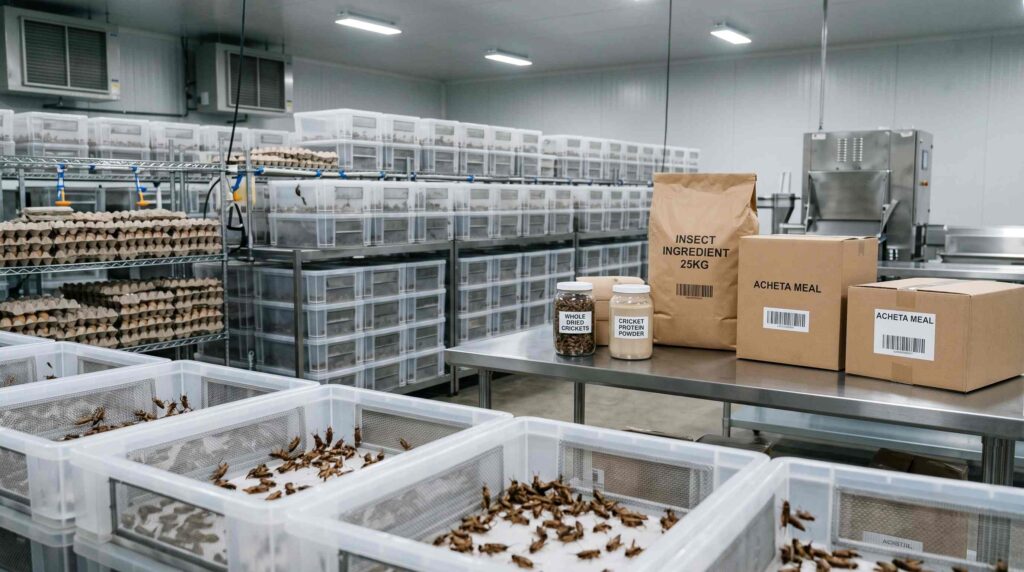
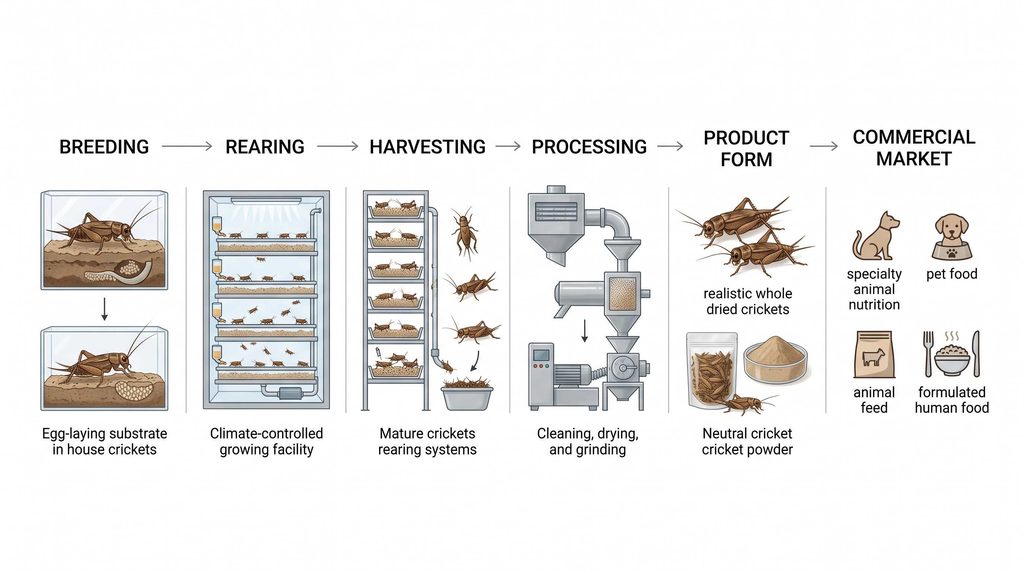
Commercial cricket production requires breeding populations, egg laying and incubation, nymph development, feeding, environmental management and harvesting. Indoor production allows these stages to be organised into recurring cohorts rather than depending on seasonal wild collection.
The production environment matters because temperature, housing conditions, nutrition and stocking management can affect growth and survival. Feed composition can also influence both production performance and the characteristics of the harvested cricket, which means farming decisions can eventually affect downstream product quality.
At industrial scale, the challenge changes from simply keeping crickets alive to producing predictable biomass. Breeding, hatching, feeding, environmental control, harvesting, and processing all need to operate at compatible throughput if the facility is to deliver consistent commercial volumes.
3. Feed Strategy Influences Both Yield and Product Characteristics
Feed is a central production input because crickets need diets capable of supporting rapid growth and consistent survival. Research into alternative diets and food-system by-products reflects industry interest in reducing input costs and improving resource utilisation.
Feed strategy cannot be evaluated only according to the cost of the substrate. Experimental work has shown that different diets can affect fresh cricket yield, while broader reviews indicate that diet can influence growth and nutritional composition.
Regulation creates another boundary. The fact that crickets can biologically consume a particular organic material does not automatically mean that substrate is permitted for insects destined for commercial food or feed. Commercial circularity therefore remains constrained by feed-safety and market-access requirements.
4. Harvesting and Processing Determine What Can Be Sold
Harvested crickets are perishable biological material. Commercial operations therefore need post-harvest systems capable of killing or stabilising the insects, controlling microbiological risk and converting the biomass into a product suitable for storage and distribution.
The processing route depends on the intended market. Crickets can remain whole and be dried, roasted or otherwise processed, while further milling can create cricket powder or flour. Additional processing can modify fat content or create ingredients with different technological properties.
Research on A. domesticus shows that processing conditions can affect nutritional, microbiological, and technological characteristics. A systematic review found that feed and processing contribute to variation in composition and that heating is important for improving microbiological safety and stability.
5. Whole Crickets Remain a Distinct Commercial Product
Unlike insect sectors focused predominantly on processed protein meal, part of the cricket market continues to trade the insect in recognisable whole form. Whole dried crickets can serve specialty animal, feeder and certain human-food markets.
This changes the commercial specification. Buyers of whole products can evaluate size, colour, cleanliness, physical integrity and moisture condition alongside nutritional characteristics. Breakage and appearance may matter more than they would for material destined immediately for milling.
Whole-product markets also create different distribution channels. Importers, wholesalers, specialty animal businesses, and food distributors can participate between the producer and final user, making commercial cricket supply more fragmented than a conventional bulk ingredient chain.
6. Cricket Powder Expands the Ingredient Market
Grinding processed crickets into powder changes both the physical product and the potential customer base. The insect becomes easier to incorporate into formulated products without retaining the appearance of a whole cricket.
Research has identified useful technological properties in A. domesticus ingredients, including water retention, oil retention, gel formation and emulsification. These characteristics have supported investigation of cricket ingredients in bakery products, pasta, snacks and other formulated foods.
Powder therefore creates a different commercial proposition from whole crickets. Buyers increasingly evaluate composition, particle characteristics, functionality, safety, documentation and consistency rather than visible insect appearance.
7. Specialty Animal and Pet Markets Provide an Established Base
Crickets have a long commercial history as feeder insects for reptiles and other animals. Scientific reviews describe A. domesticus as one of the widely farmed insects and note the significance of the pet and reptile feeder market.
These markets can involve live, dried, or processed products depending on the customer and distribution model. For dried products, stability and ease of transport can create a different commercial proposition from live feeder insects.
Pet-food applications can also extend beyond recognisable whole insects. Processed cricket ingredients can be incorporated into formulated products, moving cricket supply closer to the ingredient model seen elsewhere in animal nutrition.
8. Aquafeed and Livestock Feed Expand the Addressable Market
Cricket ingredients have also been investigated for animal-feed applications, including fish and poultry. Reviews of A. domesticus describe research and use across fish, poultry, and pet nutrition, while the regulatory treatment of insect-processed animal protein has created pathways for specified feed applications in markets such as the European Union.
The potential volume of industrial feed is much larger than many specialty markets, but the commercial requirements are also different. Feed manufacturers need predictable nutritional specifications, reliable supply, and prices that work within established formulation economics.
Research demonstrating nutritional suitability therefore does not automatically establish large-scale commercial demand. The transition from technical potential to repeat procurement depends on regulation, cost, available volume, and performance relative to established ingredients.
9. Human Food Is a Major Differentiating Market
Human food is particularly important to the structure of the cricket sector. Cricket consumption has a long cultural history in parts of Asia, while Western markets have increasingly explored crickets as ingredients in processed foods.
The European Union provides a clear example of formal regulatory market access. Frozen, dried and powder forms of Acheta domesticus were authorised as Novel Food in 2022, followed by partially defatted powder in 2023 under specified conditions.
Those authorisations demonstrate regulatory access, not the size of consumer demand. Actual adoption still depends on product formulation, consumer acceptance, sensory characteristics, allergen management, labelling and price.
10. Food Formulation Can Reduce Dependence on Whole-Insect Acceptance
One commercial challenge facing edible insects is that consumers may respond differently to a visible insect than to an ingredient incorporated into a familiar food. Cricket powder allows manufacturers to separate the nutritional ingredient from the visual appearance of the whole insect.
EU regulatory applications illustrate the range of potential formulations. Applications and authorisations have considered cricket ingredients for categories including bakery products, pasta, snacks and other formulated foods.
This does not guarantee mainstream consumer adoption, but it creates a broader product-development pathway. For cricket producers, food demand can therefore involve both direct whole-insect consumption and B2B ingredient supply to manufacturers.
11. Processing Can Create More Specialised Ingredients
Further processing can move the industry beyond basic dried crickets and whole-insect powder. Partially defatted powder is already represented within the EU Novel Food framework, while research continues to investigate the technological characteristics of cricket-derived ingredients.
The commercial logic is similar to other insect-processing sectors: additional processing may produce ingredients better suited to particular formulations, but it also introduces equipment, energy, yield and quality-control requirements.
More processing should therefore not automatically be interpreted as more value. Commercial viability depends on whether buyers will pay sufficiently for the resulting ingredient to justify the additional manufacturing complexity.
12. Food Safety and Allergen Management Are Central to Commercialisation
Food and feed commercialisation requires more than nutritional composition. Microbiological control, feed safety, contaminants, processing and storage all influence whether cricket products can be supplied consistently into regulated markets.
Allergenicity is also an important consideration. Recent reviews of A. domesticus highlight allergenic reactions and potential cross-reactivity among the issues that need to be managed when developing cricket-based foods.
This places quality management across the entire production chain:
As the cricket sector moves further into manufactured food and feed ingredients, traceability and process control become increasingly important components of commercial capability.
13. Disease Risk Is a Distinctive Production Constraint
Disease deserves particular attention in the cricket industry because commercial A. domesticus populations have historically experienced serious viral outbreaks. Acheta domesticus densovirus, or AdDV, can cause high mortality and colony collapse, creating a direct threat to production continuity.
The issue remains relevant rather than purely historical. Research published in 2025 and 2026 continues to investigate viral prevalence, viral loads, and AdDV transmission in commercial or production populations.
Biosecurity therefore becomes an economic as well as biological consideration. Breeding-stock health, sanitation, population management and disease surveillance can influence whether nominal production capacity translates into reliable commercial output.
14. Production Capacity Is Not the Same as Commercial Supply
A commercial cricket facility can be described by rearing area, production units, or planned annual capacity, but none of these figures necessarily represents the quantity of product available to buyers.
Biological performance, disease, harvesting efficiency, processing throughput, and quality release can all reduce finished-product output. The distinction is particularly important for cricket production because colony-level disease events can disrupt the biological side of the system before processing capacity is even reached.
For IIR analysis, capacity is therefore better understood as:
The further the measurement moves towards delivered volume, the more useful it becomes for understanding actual market supply.
15. Regional Market Structures Differ
The global cricket sector has not developed through one uniform commercial model. Thailand provides an established example of farmed edible insects moving through production, processing and market channels, with cricket farming developing over decades.
North America developed a substantial commercial feeder-cricket sector, while newer food businesses have expanded the role of crickets as processed ingredients. Europe has followed a more explicitly regulated Novel Food pathway for human consumption, with specific A. domesticus product forms authorised for defined uses.
Regional comparisons therefore need to distinguish traditional food demand, feeder-insect demand, processed-food development and regulatory market access rather than assuming the same industry structure everywhere.
16. Market Structure Depends on Product Form
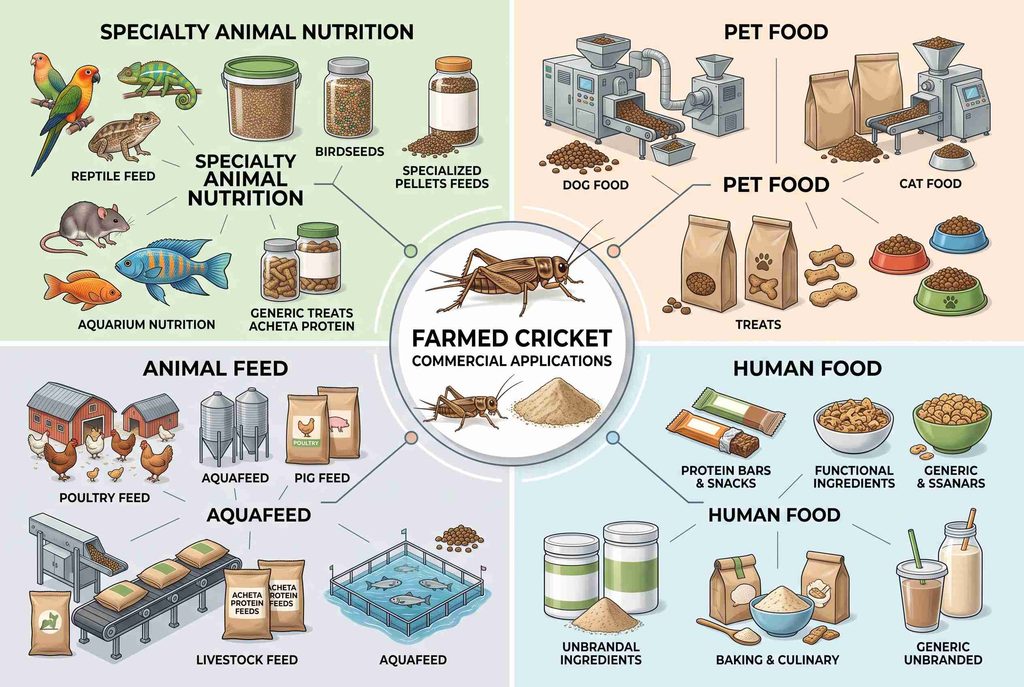
There is no single commercial market for crickets. The same species can enter several product chains:
Further Processed Ingredients → Emerging Formulation Opportunities
Each pathway involves different buyers, specifications, and economics. A producer’s addressable market therefore depends not only on farming capacity but also on processing capability, regulatory access and the product forms it can deliver consistently.
What Could Drive the Next Stage of the Cricket Industry?
The next stage of industry development will depend partly on whether producers can make biological production more predictable. Better biosecurity, breeding management, environmental control and automation could reduce variability and improve the relationship between installed capacity and actual output.
Processing and market positioning will matter just as much. Whole crickets can continue serving established specialty markets, while powders and processed ingredients can provide access to food, pet and feed manufacturers that require more standardised inputs.
Regulation can open additional addressable markets, but regulatory approval alone does not create demand. Commercial development becomes more meaningful when authorised products are supported by repeat customers, stable production and economics that allow both producer and buyer to operate sustainably.
IIR Analysis
The cricket industry differs from several other insect sectors because it combines a long-established whole-insect business with a developing processed-ingredient industry. Feeder insects and traditional food markets existed well before the recent expansion of alternative-protein investment, while powders and processed ingredients have created newer B2B opportunities.
House cricket is central to this development, but species-level production risk remains important. The historical and continuing relevance of AdDV demonstrates that industrial insect farming cannot be evaluated only through feed conversion, facility size, or theoretical output. Biological resilience and biosecurity directly influence commercial supply.
Human food provides another distinctive pathway. EU Novel Food authorisations demonstrate that specified A. domesticus products can achieve formal regulatory access, while current research continues to examine their nutritional, technological and safety characteristics. That is meaningful industry infrastructure, but it should remain analytically separate from claims about realised consumer demand.
For IIR, the strongest indicators of industry development are therefore actual production, disease-resilient farming, processing capability, regulatory market access and repeat commercial demand. Together, these measures provide a more useful picture of commercial maturity than facility announcements or potential applications alone.
Disclaimer: This article is for informational purposes only and does not constitute business, legal or investment advice. Always consult primary sources and qualified professionals.