The company operating Agronutris' black soldier fly facility in Rethel has entered court-supervised reorganisation while continuing production and customer supply.
Agronutris’ Rethel insect facility has entered court-supervised reorganisation, putting renewed attention on the financial and operational pressures facing industrial-scale insect production in Europe.
By IIR Editorial Desk · September 21, 2026 · Latest Coverage
What Happened at Agronutris’ Rethel Facility
The company operating the Agronutris BSF facility in Rethel, France, has entered court-supervised reorganisation while continuing its industrial operations and customer supply.
On September 3, 2026, the Commercial Court of Sedan opened redressement judiciaire proceedings concerning Ardennutris, the entity associated with the operation of Agronutris’ black soldier fly facility in Rethel. The French procedure allows a company to continue operating under court supervision while its financial position and potential restructuring are assessed.
The development is significant because the Rethel site represents part of Europe’s push to commercialize black soldier fly production at an industrial scale. Agronutris says its activities focus on breeding and processing black soldier flies into ingredients for animal nutrition and agricultural applications.
Production Continues During the Proceedings
The opening of the procedure does not mean that production at Rethel has stopped.
The Fish Site reported that the facility continues to produce and supply customers. Agronutris co-founder and general manager Cédric Auriol described the procedure as a protective measure intended to provide the facility with time and stability while the business reorganises.
A more recent French report published on September 17 also said that operations at the Rethel facility were continuing. According to comments attributed to Auriol in that report, the site continues processing black soldier fly larvae into protein and lipid ingredients while also producing insect oil and frass.
The court-supervised observation period provides an opportunity to assess whether the business can establish the financial conditions necessary for continued operations. Public corporate registry information currently lists Ardennutris as active but subject to an ongoing collective proceeding.
Why the Rethel Facility Matters
Agronutris has positioned Rethel as the industrial center of its black soldier fly production strategy.
The company says its first Rethel factory opened in 2022 and includes infrastructure covering breeding, bioconversion, and insect processing. Agronutris has concentrated its industrial model on Hermetia illucens, the black soldier fly.
When the first production building was inaugurated in 2022, Agronutris described it as a 16,000-square-meter facility on a nine-hectare site. At the time, the company said the plant was designed to valorize 70,000 tonnes of local co-products eventually. Those figures represent company-announced design ambitions rather than evidence of current production volumes.
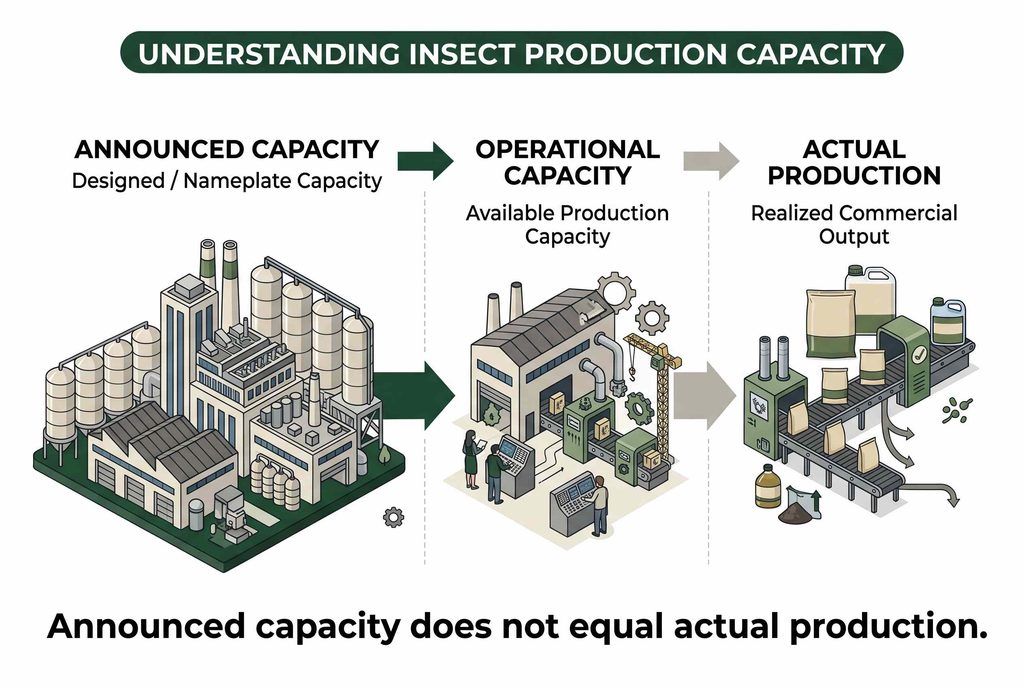
That distinction is particularly important when evaluating the black soldier fly industry. Announced capacity, installed capacity, and actual commercial output are different measures of industrial development.
A Broader Test for Industrial Insect Production
The Agronutris development comes as European insect producers continue to test whether technically viable insect production systems can also achieve durable commercial viability.
Industrial black soldier fly production requires more than biological efficiency. Producers must secure suitable feedstocks, maintain stable rearing conditions, operate processing equipment, meet feed safety requirements, and develop reliable demand for protein meal, oil, and other products.Large facilities also require substantial capital before reaching stable utilization levels.
The Rethel proceedings, therefore, should not automatically be interpreted as evidence that black soldier fly production itself is commercially unviable. Instead, they illustrate the distinction between the technical ability to produce insect ingredients and the financial requirements of scaling that production into an industrial business.
Agronutris’ own earlier expansion plans demonstrate the scale of those ambitions. The company previously outlined plans for additional production capacity at Rethel and further international expansion.
Production Capacity Remains a Key Industry Metric
For buyers, investors, and industry observers, the situation reinforces the need to carefully examine insect production capacity.
A facility may have a stated or nameplate production capacity substantially above its actual output during ramp-up. Commercial production can be affected by utilization rates, biological performance, feedstock availability, processing efficiency, and customer demand.
IIR therefore distinguishes between announced capacity, operational capacity, and actual production when assessing insect-industry development.
This distinction will become increasingly important as the sector moves from construction and fundraising toward sustained production and commercial execution.
What to Watch Next
The immediate issue is how Ardennutris progresses through the court-supervised observation period.
The September 3 court decision opened the judicial reorganisation proceedings and scheduled further judicial review to determine whether the company has sufficient financial capacity to continue operations. Public records and reporting indicate that the facility is continuing to operate during the proceedings.
For the wider insect-protein market, several developments will be worth monitoring: continuity of production at Rethel, customer and supplier relationships, financing arrangements, potential restructuring measures, and the facility’s ability to move toward sustainable utilization.
The outcome will also provide another case study in how Europe’s industrial insect sector manages the transition from capital-intensive scale-up to long-term commercial operation.
Disclaimer: This article is for informational purposes only and does not constitute business, legal or investment advice. Always consult primary sources and qualified professionals.