Independent intelligence for the global insect industryISSUE 01 · 2026
Singapore Edible Insects Expand Further Into Mainstream Retail
By IIR Editorial DeskSeptember 19, 2026
Singapore’s edible insect market is moving beyond regulatory approval toward broader consumer distribution, with Insectyumz continuing to expand its retail presence.
By IIR Editorial Desk · September 20, 2026 · Latest Coverage
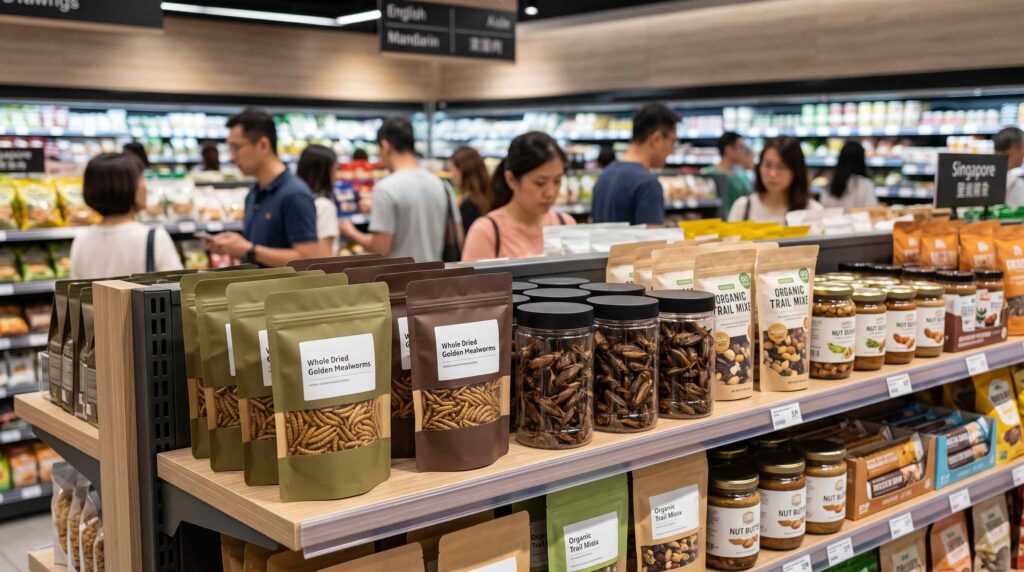
Singapore edible insects are continuing their transition from regulatory novelty to commercially available food products as local brand Insectyumz expands its presence across additional consumer channels.
Insectyumz listed a new retail milestone on September 18, announcing that its products are now available through Playhao. The development follows a broader expansion that has already placed the company’s edible insect snacks across several of Singapore’s major supermarket networks.
Taken alone, the addition of another retail location is relatively small. Viewed as part of the company’s distribution history, however, it raises a more important question facing the edible insect industry: what happens after regulators allow insect-based foods to enter the market?
For Singapore, that question is increasingly shifting from regulatory approval toward consumer adoption.
From Regulatory Approval to Commercial Distribution
Singapore opened the market for selected edible insects in July 2024, creating a regulatory pathway for insects and insect products intended for human consumption.
Insectyumz launched shortly after that change and describes itself as an importer and supplier of edible insects for the Singapore market.
The company’s subsequent expansion provides a useful example of how an emerging insect-food category can develop once regulatory access is established.
According to its published brand history, Insectyumz began selling dried mealworm snacks in Singapore in August 2024. By December of that year, its mealworm product had entered all 76 Sheng Siong stores.
Expansion continued during 2025.
Tom Yum cricket snacks were introduced across Sheng Siong stores in January, followed by distribution through FairPrice and Cold Storage Group outlets later in the year. The company says its flagship cricket and mealworm products eventually reached all three major supermarket groups.
That progression matters more than any individual store announcement.
It shows an edible insect company moving through several stages of commercialization: initial regulatory entry, specialist sales, supermarket distribution, and broader consumer exposure.
Retail Availability Does Not Equal Consumer Adoption
Distribution, however, should not be confused with market acceptance. Getting insect products onto supermarket shelves solves only one part of the commercialization problem. Consumers still have to notice the category, understand the product, and decide to purchase it — potentially more than once.
This is particularly important for whole-insect products. Unlike protein powders or ingredients incorporated invisibly into formulated foods, dried mealworms, crickets, locusts, and similar products retain a recognizable insect appearance. For some buyers, that visibility may strengthen novelty and experiential appeal; for others, it can remain a significant barrier to trial.
As a result, retail expansion provides distribution data, but it does not by itself establish whether edible insects are developing into a repeat-purchase food category.
That distinction will be important as Singapore’s market develops.
Consumer Education Is Becoming Part of Distribution
Insectyumz has not relied solely on supermarket shelves.
During 2026, the company will also participate in community markets and public events where consumers can see and sample edible insect products.
Its September activities included a Central Singapore Market event where products such as crickets, mealworms, locusts, silkworms, and honeybees were presented to consumers.
This type of direct sampling can play a different role from conventional retail distribution.
For unfamiliar food categories, the purchasing barrier is often not simply price or availability. Consumers may have questions about safety, taste, preparation, and why they would choose insects over familiar foods.
Sampling creates an opportunity to address those barriers directly.
For the broader edible insect sector, this suggests that market development may require a combination of distribution and education, rather than distribution alone.
Singapore Edible Insects Offer an Interesting Test Market
Singapore occupies an unusual position in the Asian edible insect landscape.
In parts of Southeast Asia, insect consumption has long-standing culinary traditions. Singapore, by contrast, has developed its modern edible insect market through a highly regulated commercial food system.
That makes the country particularly useful for observing how insect products perform in conventional modern retail channels.
The market now includes products made from several insect species, while regulatory requirements establish controls around permitted species, farming and processing conditions, and food safety.
The next stage is commercial rather than regulatory.
Brands must determine which product formats consumers are willing to try, which channels drive repeat purchases, and whether insects remain a novelty snack or become a broader food category.
What the Industry Should Watch Next
The expansion of Singapore edible insects should therefore be measured by more than the number of retail outlets carrying them.
Three indicators will be more important over time.
The first is repeat purchasing. Initial curiosity can generate trial sales, but sustainable categories depend on consumers returning to the product.
The second is product format. Whole dried insects may attract adventurous consumers, while powders, protein ingredients, and formulated foods could eventually appeal to different audiences.
The third is distribution durability. Maintaining supermarket shelf space over multiple product cycles would provide stronger evidence of demand than a short-term launch.
Insectyumz’s expanding retail footprint shows that edible insects can move from regulatory approval into conventional consumer distribution.
The more important question now is whether availability develops into sustained demand.
For Singapore edible insects, sustained consumer demand will be the next important commercial test.
Disclaimer: This article is for informational purposes only and does not constitute business, legal or investment advice. Always consult primary sources and qualified professionals.