Independent intelligence for the global insect industryISSUE 01 · 2026
Global Insect Protein Industry: Market Overview | IIR
By IIR Editorial DeskSeptember 13, 2026
Explore the global insect protein market reality. IIR projects true operational capacities, B2B demand drivers, and timeline for price parity.
Published: September 13, 2026 | Fact-checked by: IIR Research Team | Data Projections: IIR Market Intelligence
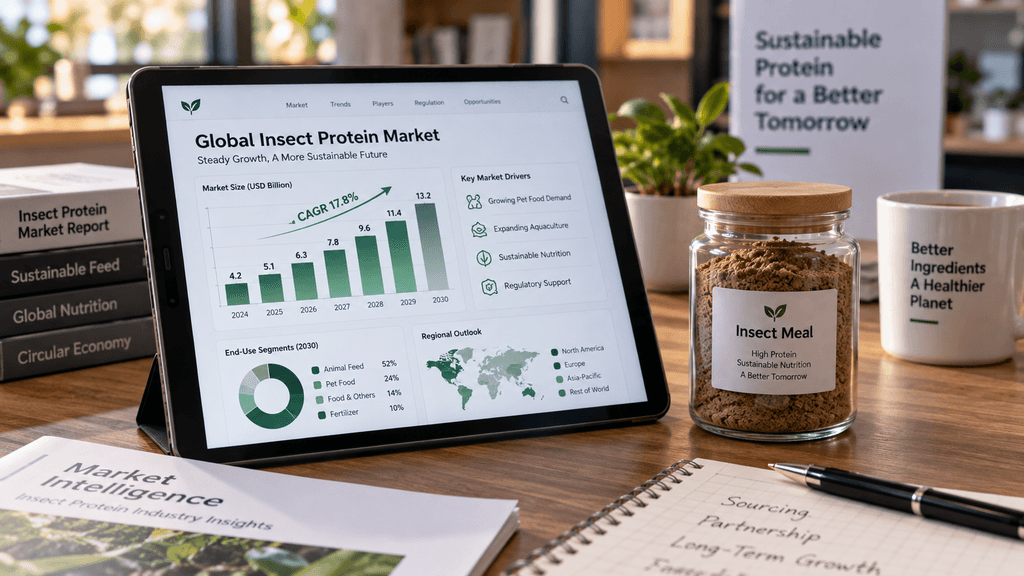
Moving beyond the initial hype of “saving the planet,” the insect protein sector is now entering its mature industrial phase. This IIR market overview provides a realistic assessment of the global landscape, analyzing true operational capacities, dominant commercial applications, and the structural costs dictating the timeline for fishmeal price parity.
For over a decade, the narrative around the insect protein industry has been dominated by sustainability promises and venture capital funding announcements. However, for procurement managers, formulators, and institutional investors, the conversation has fundamentally shifted. The industry is no longer being judged on its environmental potential, but on its manufacturing execution, supply chain resilience, and unit economics.
As the sector transitions from pilot facilities to commercial-scale gigafactories, buyers need transparent data to make strategic formulation decisions. This report strips away the promotional marketing to provide a pragmatic overview of the global insect protein market, focusing on actual demand drivers, operational capacity realities, and cost structures.
1. Core Drivers of the Commercial Market: Beyond the Green Halo
While the circular economy remains a strong tailwind, the actual purchasing decisions in the B2B purchasing decisions are driven by supply chain security and functional performance.
Supply Chain Resilience vs. Fishmeal Volatility: Data from the FAO (Food and Agriculture Organization) highlights that the global aquaculture and early-stage livestock sectors are heavily reliant on marine ingredients, primarily Peruvian anchoveta fishmeal. Climatic events like El Niño routinely devastate these quotas, causing massive price spikes and supply shortages. Insect meal, predominantly from Black Soldier Fly Larvae (BSFL) and Yellow Mealworms, offers a terrestrial, climate-independent alternative. Buyers are increasingly motivated by the need to de-risk their protein supply chains rather than solely seeking sustainability credentials.
Functional Nutritional Demand: We are moving past the concept of insect meal as merely a bulk “protein filler.” Advanced formulators are purchasing these ingredients for their functional properties. The high lauric acid content in BSFL oil is actively sought for its antimicrobial properties in piglet creep feeds, while the specific amino acid profile and high digestibility of defatted insect meal are proving essential in premium carnivorous aquafeeds.
2. Commercial Applications: Where is the Volume Actually Going?
The market is heavily segmented. While the theoretical applications for insect protein are vast, the current commercial reality is highly concentrated in sectors that can absorb the early-stage price premiums.
Pet Food (The High-Margin Driver): According to market analyses by Rabobank, premium pet food is currently the financial backbone of the insect agriculture industry. Dogs and cats are historically accustomed to consuming insects, and pet owners are highly receptive to novel, hypoallergenic protein sources.
IIR Market Projection: Based on current offtake agreements and shipment volumes, IIR estimates that the premium pet food sector currently absorbs approximately 65% to 70% of the globally available high-grade, mechanically defatted insect meal. This sector’s tolerance for higher raw material costs ($3,500 – $5,000+ per metric ton) allows insect producers to maintain margins while refining their industrial processes.
Aquafeed (The Volume Frontier): Aquaculture represents the true “volume play” for the insect sector. Salmonids, shrimp, and other high-value carnivorous species require highly digestible protein. However, the aquafeed market is notoriously sensitive to price. While major feed millers (like Skretting and BioMar) have established strategic partnerships with leading insect producers, mass integration is pending further cost reductions.
Poultry and Swine: Currently, inclusion in commercial poultry and swine diets remains low due to strict unit cost constraints. In these sectors, insect ingredients are primarily utilized in specialized, early-stage nutrition (such as starter feeds) where the functional benefits of gut health outweigh the higher cost per ton.
3. The Capacity Reality: Planned Announcements vs. Operational Output
The most significant pain point for procurement managers today is securing consistent, commercial-scale volumes (e.g., fulfilling 50-100 metric ton monthly contracts). The industry frequently suffers from a severe disconnect between press-release capacity and actual factory output.
The Biological Scaling Bottleneck: Insect agriculture is not simply a matter of building a larger warehouse; it is a highly complex biological engineering challenge. Maintaining optimal heat, humidity, and airflow to sustain billions of living organisms simultaneously is incredibly difficult. A failure in HVAC systems or a drop in the neonate reproduction rate can crash a facility’s yield within weeks.
IIR Capacity Projections: While the global “planned” or “nameplate” capacity of announced mega-facilities often exceeds hundreds of thousands of tons, the reality on the ground is different. IIR estimates that the actual operational output for high-grade insect meal globally currently sits at roughly 40% to 50% of publicized figures. This gap is the result of commissioning delays, biological learning curves, and the complexities of scaling automated processing lines. Buyers must aggressively audit a supplier’s historical shipment data rather than relying on future blueprint projections.
Dominant Species Consolidation: The market has clearly consolidated around two primary species. The Black Soldier Fly (Hermetia illucens) dominates the bulk feed and aquafeed space due to its rapid growth cycle and aggressive bioconversion capabilities. The Yellow Mealworm (Tenebrio molitor) is carving out a premium niche, particularly in the European market, heavily targeting premium pet food and specialized human food applications due to its milder flavor profile and high protein density.
4. Cost Structures and the Timeline to Price Parity
For insect meal to unlock the millions of tons required by the global aquafeed and livestock sectors, it must achieve price parity with super-prime fishmeal and high-pro soy products. Understanding the cost structure is vital for buyers anticipating future price drops.
The CAPEX and OPEX Reality: Early-generation insect facilities were highly manual, leading to unsustainable OPEX (labor costs). The current generation of gigafactories has shifted toward heavy automation (robotics, automated climate control, continuous processing). This transition has drastically increased CAPEX (capital expenditure). Therefore, current insect meal prices are artificially inflated by the need for these heavily funded companies to amortize their massive initial factory investments.
Substrate (Feedstock) Volatility: The profitability of an insect facility is intrinsically linked to its substrate sourcing. In regions like the EU, strict regulations—often guided by frameworks from IPIFF (International Platform of Insects for Food and Feed)—limit feedstock to pre-consumer vegetal waste. As the insect industry scales, competition for these specific, clean waste streams (like brewery grains or bakery by-products) is intensifying, driving up the cost of what was previously considered “free waste.”
When Will Price Parity Occur? The industry frequently markets the idea that price parity with fishmeal is imminent. However, a pragmatic analysis of current energy costs, automation amortization, and feedstock competition suggests a longer timeline.
IIR Cost Projection: Based on the trajectory of biological optimization (e.g., selective breeding for larger larvae) and the scaling of next-generation automated facilities, IIR analysis suggests that premium BSFL meal will likely not reach strict, consistent price parity with super-prime fishmeal (historically fluctuating between $1,800 – $2,200 per MT) until the 2028-2029 operational window.
5. Strategic Takeaways for B2B Procurement
The global insect protein market is rapidly maturing from a novel R&D project into a legitimate industrial supply chain. For buyers, the strategy must shift from “testing novel ingredients” to “securing reliable supply.”
Prioritize Operational Reality: Discount future capacity announcements. Evaluate suppliers based solely on current, auditable monthly dispatch volumes.
Focus on Functional Value: In the short term, formulate with insect ingredients to leverage their functional benefits (antimicrobial properties, palatability) rather than treating them as a cheap, 1-to-1 protein substitute.
Prepare for the Tipping Point: While price parity with fishmeal is projected for 2028-2029, securing long-term off-take agreements with mature producers today will guarantee supply security when the broader market inevitably pivots to insect-derived proteins.
By understanding the realistic dynamics of capacity and cost, forward-thinking manufacturers can safely integrate this vital protein source into their long-term supply chain strategies.
Disclaimer: This article is for informational purposes only and does not constitute business, legal or investment advice. Always consult primary sources and qualified professionals.